
|
Celebrities and Famous Brummies Past and Present
(Birmingham born and bred).
|
||
| Asbury, Bishop Francis (1745-1816) | ||

|
Bishop Francis Asbury the founder of the American Methodist Church, lived in Newton Road, Great Barr, Birmingham until 1771 when he left for the New World and Evangelism. >More | |
|
|
||
| Attwood, Thomas (1783�1856), | ||

|
Born 6 October 1783 at Halesowen, Thomas Attwood joined his father's banking firm in Birmingham in 1800. In 1811 he was elected high bailiff of Birmingham and subsequently became concerned with fairer representation in the House of Commons. Attwood and fifteen others met to form the Birmingham Political Union for the Protection of Public Rights Union for the Protection of Public Rights 14 December 1829; the BPU united the middle-and lower-classes in the movement for fairer representation in parliament and became a major influence on the government's passing of the Reform Act 1832. After the Reform Act Attwood was elected a MP for Birmingham and sat in the House of Commons until 1839. He died 6 March 1856 at Great Malvern. | |
|
|
||
| Austin, Albert (1882�1953), | ||

|
Albert Austin Silent film start was born in Birmingham, England, died
August 17, 1953 in North Hollywood, California. Albert Austin was the
tall, handsome (without makeup and false facial hair), frizzy-haired
character man for the Chaplin Stock Company,
 more
more
|
|
|
|
||
| Austin, Herbert (1866-1941) | ||
|
|
Herbert Austin was born at Little Missenden in Buckinghamshire 8 November 1866. After Rotherham Grammar School and Brampton College, he emigrated at age 17 to Australia with his uncle, and became an engineering apprentice. He improved sheep shearing machines, and ten years later was sent by his employer Frederick Wolseley to England to supervise their manufacture. In his spare time he built a three-wheeled tiller-steered motor car 1895; the following year his first four-wheeler was exhibited at Crystal Palace. By 1900 he had founded the Longbridge factory covering just over 1 hectare and producing 120 cars a year. By 1914 Austin was producing 1500 cars a year. During World War 1 the factory made munitions; he was knighted in 1918. After the war he was elected MP for Kings Norton and served for 6 years In 1936 he became Lord Austin of Longbridge. During the inter-war years he designed the Austin 20, the Austin 12 and the Austin 7. Again in 1939 factory production was turned over to the war effort. Lord Austin died 1941. | |
|
|
||
| Baskerville, John (1706�1775), | ||

|
John Baskerville designer of type and printer. born in Wolverley, Worcestershire, and moved to Birmingham in 1725 where Baskerville House and the Baskerville steps in Centenary Square are testament to his memory. The present day Baskerville House is on the original site of his eight acre estate and house. John Baskerville is famous for his Baskerville font but he also improved the way in which metal type was made. John Baskerville died in 1775 a An atheist he was buried in the conical base of a disused windmill in his own garden. Baskerville was disinterred when canal wharves, the New Wharves were built 1821, his remains transferred after some years to Christ Church catacombs (New Street/ Colmore Row) and on the church�s demolition 1893 reburied 1898 at the Church of England Cemetery Warstone Lane in a vault beneath the chapel which was demolished 1953 but with the vaults intact. | |
|
|
||
| Benson, Edward White, (1829�1896) | ||

|
Edward White Benson Born: July 14, 1829 was educated at King Edward�s School in Birmingham, and at Trinity College, Cambridge. He subsequently became a fellow of Trinity College. In 1852, he passed from Cambridge to Rugby as assistant master; in 1859 from Rugby to Wellington College, where he was headmaster for 14 years; in 1872 from Wellington College to Lincoln, as chancellor of the cathedral; in 1877 from Lincoln to Truro, as first bishop of that diocese. He left Truro in 1883 to become Archbishop of Canterbury. He also served as Prebendary of Lincoln and Chaplain to the Queen. Died: October 11, 1896, Hawarden, England. A Blue Plaque to mark his birth place was placed on a building at Lombard Street, Balsall Heath. in 1984 by Birmingham Civic Society | |
|
|
||
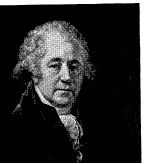
| Boulton, Matthew (1728�1809) | ||
|
Matthew Boulton, son of a silver-worker was born in Birmingham 1728. He
worked with his father and after his death he bought land on Birmingham
Heath at Soho where he built the Soho Manufactory minting coins amongst
other many things. Boulton went into partnership with James Watt 1773
and for 11 years the factory made Watt's steam-engines for colliery
owners to pump water out of the mines, the Boulton & Watt engine
being four times more powerful than Thomas Newcomen's original design.
Watt marketed his rotary-motion steam engine from 1781. The earlier
steam engine's vertical movement was ideal for operating water pumps but
the new engine could be adapted to drive all sorts of machinery. Richard
Arkwright pioneered its use in his cotton mills and within 15 years
there were 500+ Boulton & Watt steam engines in British factories
and mines. In 1786 Boulton applied steam power to minting coins at Soho.
He died in 1809.
more
|
|
|
|
||
| Burne-Jones, Edward (1833�1898) | ||

|
Edward Burne-Jones artist. Sir Edward Coley Burne-Jones; professional name of Edward Coley Jones, was an English painter, designer, and illustrator, born in Birmingham and educated at the University of Oxford. Trained by the Pre-Raphaelite painter Dante Gabriel Rossetti, Burne-Jones shared the Pre-Raphaelites' Burne-Jones was also prominent in the revival of medieval applied arts led by his Oxford friend the poet and artist William Morris. For Morris's firm he designed stained-glass windows, mosaics, and tapestries. His windows can be seen in many English churches, including Christ Church, Oxford, and Birmingham Cathedral. He also illustrated books of Morris's Kelmscott Press, notably Chaucer (1896). Burne-Jones was knighted in 1894. | |
|
|
||
| Cadbury, George (1839�1922), | ||
|
|
George Cadbury was born in Edgbaston 19 September 1839, the son of John
Cadbury, a tea and coffee merchant in Bull Street. With his brother
Richard took over the cocoa factory 1861. George was interested in
social reform and in the provision of decent housing for working people.
He was elected to the Town Council 1877 and enthusiastically supported
Joseph Chamberlain's municipal initiatives. To escape the pollution of
the town George rebuilt the cocoa factory on a greenfield site at
Bournville 1879 where he began to develop good quality and affordable
housing for the workers, Bournville Building Estate which became
Bournville Village Trust in 1900. He was a prominent member of the
Society of Friend. George Cadbury died at his home, the Manor House
Northfield 24 November 1922 and was cremated at Perry Barr crematorium.
English Heritage has unveiled the very first Blue Plaques in Birmingham
for brothers Richard Cadbury (1835-1899) and George Cadbury (1839-1922).
at 17 Wheeley's Road, where Richard Cadbury lived from 1861 to 1871, and
just round the corner at 32 George Road, where George Cadbury lived from
1872 to 1881.
more
|
|
|
|
||
| Chamberlain, Joseph Austen (1836-1914) | ||

|
Joseph Chamberlain was born in Camberwell London, coming to Birmingham aged 18 to work for his uncle Joseph Nettlefold at his screw factory. He was elected as a Liberal town councillor 1867 and became mayor in 1873 holding the office for three successive years. He was responsible for domestic gas and electricity, the building of Corporation Street and the beginnings of slum clearance; largely thanks to Chamberlain Birmingham famously became known as 'the best governed City in the World'. He entered Parliament 1876 and became Gladstone's President of the Board of Trade 1880. He was largely responsible for the fall of the Liberal government following which he led the Liberal Unionists who joined a coalition with the Conservatives; Salisbury appointed him Colonial Secretary 1895 after which Chamberlain was instrumental in directing government colonial policy during the Boer War. He built and lived at Highbury in Moor Green now owned by the City; his library remains intact. Chamberlain suffered a stroke 1906 and left politics; he died 1914. He was married three times; his eldfest son was Austen Chamberlain; his son by his second marriage was Neville Chamberlain, a son of his second marriage also became Lord Mayor of Birmingham and Prime Minister. | |
|
|
||
| Chamberlain, Neville (1869�1940), | ||
|
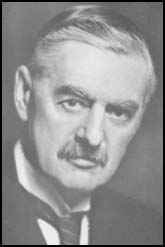
Arthur Neville Chamberlain was born at South Bourne Edgbaston, the son of Joseph Chamberlain by Florence Kenrick, his second wife. Joseph sent him to the Bahamas to run a large sisal estate at the age of 22; when this failed he returned to join Elliott's Metal Company Selly Oak where he eventually became chairman. He also later became chairman of Hoskins & Sons Bordesley, ships' berth manufacturers and a board member of the BSA Birmingham Small Arms Company. In 1911 he was elected as councillor for All Saints Ward and appointed to the Town Planning, Public Health and Housing Committees. He became Lord Mayor 1915. Chamberlain was instrumental in setting up the City of Birmingham Symphony Orchestra CBSO and the Birmingham Municipal Bank which enabled ordinary people to have bank accounts. After World War 1 he was elected Conservative MP for Ladywood becoming Stanley Baldwin's Health Minister 1924 and Ramsey MacDonald's Chancellor 1931. He became Prime Minister 1937 and negotiated the Munich Agreement, a peace settlement with Hitler. Hitler, however, invaded Poland and Chamberlain reluctantly declared war on Germany 1939. Lacking Labour and Liberal support he resigned as Prime Minister 1940. He continued in Winston Churchill's War Cabinet for only a few months when he resigned due to ill health; he died at his country estate, Heckfield House in Hampshire 9 November 1940 and is buried in Westminster Abbey. | |
|
|
||
| Cox, David (1783�1859) | ||

|
Born 29 April 1783 in Heath Mill Lane Deritend David Cox was apprenticed at 15 to a painter of miniatures but soon moved to theatrical scene-painting in Birmingham and London 1804. It was here that he took up the watercolour painting for which he was to become deservedly famous; he became President of the Associated Artists in Water Colour 1810. Cox lived in Hereford and in London from 1817-1840 but maintained his Birmingham connections and exhibited at the Birmingham Society of Artists in New Street. He moved to Greenfield House in Greenfield Road Harborne 1841 where he died 1859. He is buried with his wife in the churchyard at St Peter�s Harborne where he is commemorated by a stained-glass window. Birmingham Museum and Art Gallery has a fine collection of both his oils but especially watercolours which may be seen on request. | |
|
|
||
| Curry John (1949-1994) | ||

|
John Curry. Born Birmingham England, September 9, 1949 Died Stratford-upon-Avon England, April 15, 1994 Aged 44 A skater who redefined figure skating with his elegant ballet style and movement. He started at the 'old' Birmingham Summerhill Ice Rink (now demolished) with lessons from Ken Vickers. His career evolved, Junior British Champion in 1967 and senior champion in 1970. In 1976, at the age of 26, he won the European Championship and followed with a gold medal performance at the Olympics in Innsbruck, he continued onto Gothenburg for the 1976 World Championships and won. In 1976 he was voted BBC Sport's Personality of the year. He turned professional, forming his own skating company that used his theory of skating as a dance form, borrowing the grace and body lines from ballet. He gathered like-minded skaters and worked with major ballet choreographers. "The John Curry Theatre of Skating" arrived, and played to enthralled audiences. John Curry was elected to the World Figure Skating Hall of Fame in 1991. |
|
|
|
||
| Field, Sid (1904�1950) | ||

|
Sidney Field was born in Ladywood on 1 April 1904, but he spent most of his childhood at 152 Osborn Road Sparkbrook where a Birmingham Civic Society blue plaque commemorates him. He attended Conway Road, Stratford Road and Golden Hillock Road Schools and Emmanuel Church Sunday School Walford Road. His first stage appearance was with his cousins, the Workmans at Moseley Road Baths; his first professional appearance was at the age of at the age of 12 after his mother answered a Birmingham Mail advert. After 30 years touring music halls performing comedy sketches Field appeared in London�s West End as a cockney spiv and found stardom. He subsequently appeared at top venues, in film and at the Royal Variety Performance. He died of a heart attack 3 February 1950 at home in Richmond Surrey. For Field�s biography see John Fisher 1975 What A Performance! (Sid Field�s catchphrase) | |
|
|
||
| Hancock, Tony (1924-1968) | ||

|
Anthony Hancock was born 42 Southam Road Hall Green on 12 May 1924 where a Birmingham Civic Society blue plaque commemorates the fact; three years later the family moved to Bournemouth where his father kept a pub with bed & breakfast accommodation for theatrical people. During World War 2 he served in the RAF and took part in forces entertainment; after the war he took up acting professionally and worked in pantomime, in seaside summer shows and sometimes in straight theatre. In 1948 he worked at the Windmill Theatre which led to parts in radio�s Educating Archie 1951. In 1954 his famous character was created in Hancock�s Half Hour on radio and on television 1956-1960. He went to Australia to work on a TV comedy series and there committed suicide on 26 June 1968. A sculpture portraying Hancock stands in Old Square unveiled by Sir Harry Secombe 1996. | |
|
|
||
| Issigonis, Alexander (1906�1988), | ||

|
Alexander Arnold Constantine Issigonis was born in Smyrna (now Izmir) Turkey 18 November 1906; his mother was the daughter of a Bavarian brewer, his father a naturalised Briton of Greek origin who ran a marine engineering business. At the end of World War 1 1918 the British community in Turkey were evacuated by the Royal Navy; Issigonis's father died in Malta and the family arrived in England 1922. He took an engineering course at Battersea Polytechnic and by 1928 was working as a draughtsman with a London engineer developing semi- automatic transmission. He moved to the drawing office of Humber Cars Coventry and later to Morris at Cowley designing independent suspension. In the early 1940s Issigonis began work on the Morris Minor; the design team consisted only of himself and two draughtsmen to interpret his sketches. The style was influenced by the American Packard Clipper; when William Morris saw the first Minor running in 1947 he was unimpressed describing it 'a poached egg'. However, within 11 years one million Morris Minors had been sold, a record for a British car. With the Morris-Austin merger 1952 Issigonis moved to Alvis, returning to Austin in 1955 as technical director. Here he designed the revolutionary Mini small (3m) , compact, cheap and with a transverse engine. By Issigonis's death 1988 5 million had been sold. The production run in Birmingham ended in October 2000 after more than 30 years. Issigonis became a fellow of the Royal Society 1967 and was knighted 1969. He died 2 October 1988. | |
|
|
||
| Jackson, Sir Barry (1879 - 1961) | ||
|
||
|
|
||
| Ketelbey Albert (1875-1955) | ||

|
Albert Ketelbey displayed a talent for music at a young age, and by his teens was composing classical pieces. He attended Trinity College of Music in Oxford, beating out Gustav Holst in a scholarship competition. Although he achieved some critical recognition for his choral and chamber works, his greatest success was in descriptive pieces, much along the lines of Delius's "In the Fens," but with much more exotic subjects. His "In a Persian Market," "In a Chinese Temple Garden," and "In a Monastery Garden" were very popular with theater orchestras and in sheet music form. Although this type of music is now out of style, it was well considered at the time--Ketelby was in some ways the last of a line that included Johann Strauss and Franz Lehar. | |
|
|
||
| Mason, Sir Josiah (1795�1881) | ||

|
born in Kidderminster, Sir Josiah Mason was the son of a poor bombazine weaver; the pen-maker and philanthropist who founded Mason College, now developed into The University of Birmingham. A statue is located at Orphanage Road, Erdington. | |
|
|
||
| Murdock, William (1754�1839) | ||

|
William Murdock (he later anglicised it to Murdock), son of a millwright was born in Auchinleck, Ayrshire Scotland 1754. He worked for his father before joining Matthew Boulton and James Watt's company. It is said that Boulton gave him a job when he saw the wooden hat he was wearing had been turned on a home-made lathe. He was sent to Redruth Cornwall 1784 to install Boulton & Watt steam engines to pump water from the tin mines. While there he experimented with the gas given off from burning coal, and by 1792 managed to light a living-room with a gas flame. He returned to Birmingham 1799 and was made manager of the mechanical department working to improve precision on tools and products. He continued work on gas lighting and in 1802 the world's first public gas lamps were lit outside the Soho Manufactory; in 1803 Soho Foundry was entirely lit by gas. Boulton & Watt began to sell lighting and heating equipment and Murdock became become a partner in the company. Murdock died in 1839 and is buried near Boulton and Watt in Handsworth church. | |
|
|
||
| Powell, Enoch (1912-1998), | ||

|
The poet and politician John Enoch Powell MP was born in Birmingham. He studied classics at Cambridge University and became Professor of Greek at Sydney University, Australia in 1937 at the age of just 25. He returned to England at the outbreak of the Second World War and enlisted in the Royal Warwickshire regiment, where he quickly rose up the ranks from private to brigadier. On leaving the army, at the end of the war, he worked as a political researcher for the Conservative Party, before being elected as the member of Parliament for Wolverhampton South-West in 1950, the seat he held for the next 24 years. His strong stance against what he considered to be disastrously lax immigration policies led to his sacking from the shadow cabinet, following his infamous "Rivers of Blood" speech in Birmingham in April 1968. He was also firmly against joining the European Common Market, a part of the Conservative Party manifesto. He dramatically quit his party, re-entering Parliament as a Unionist MP for the constituency of Down South, Northern Ireland, which he continued to represent until losing his seat in 1992.. | |
|
|
||
| Priestley, Joseph (1733�1804) | ||

|
Joseph Priestley was born at Fieldhead near Birstall, Yorkshire 13 March 1733. Priestley was the inventor of pop. He discovered that graphite was an electrical conductor, he isolated and described the properties of carbon dioxide, nitrous oxide, and oxygen, invented pop, identified the gases involved in plant respiration and observed photosynthesis for the first time. He also isolated and described the properties of ammonia, sulphur dioxide, hydrogen sulphide, and carbon monoxide, and the decomposition of ammonia by electricity in 1781. And on 15 April 1770 he discovered that India gum would rub out pencil marks. He had invented the eraser and gave it its common name, the rubber. After working for the Lord Shelbourne Priestley moved to Birmingham to become minister of the New Meeting, reputedly the most liberal congregation in England. If his most important scientific work was done while employed by Shelbourne, he produced his most important theological work in Birmingham. He was also a prominent member of the Lunar Society, an informal group of manufacturers and professional men who shared an interest in stimulating discussions on philosophy and science; they met at full moon so there would be light to drive home by. They were nicknamed lunatics. Priestley's support for the French and American Revolutions were not approved of by some: in July 1791 a mob destroyed Priestley's chapel, house, library, and science laboratory and he fled for his life to London. By 1793 he received a settlement of his compensation claim and sailed with his wife to join their sons in Northumberland, Pennsylvania USA 1794. Priestley contracted pleurisy and after several years of ill health during which he never stopped work, he died aged 70 on 6 February 1804 | |
|
|
||
| Stone, John Benjamin (1836-1914) | ||
| Born in Birmingham, Sir Benjamin Stone was M.P. for the city, and a scholar with wide interests. The son of Mr. Benjamin Stone of Aston Manor, educated at Birmingham Grammar School, He lived at The Grange Erdington He became a documentary worker, who photographed an enormous variety of subjects, travelled widely, and wrote several books. He is remembered for his many photographs of everyday life in Victorian England. In 1895 Stone founded the National Photographic Record Association. Some of his pictures of Windsor Castle proved of considerable value recently when fire damaged part of the castle. His pictures included state and private apartments, the royal chapel and the library, and English Heritage used these as a reference, to help restore the building and furniture. Some of his many pictures (he left over thirty thousand negatives) are in the British Museum, others in the Birmingham Public Library. | ||
|
|
||
| Tolkien, John Ronald Reuel (1892�1973) | ||

|
Author. Although Tolkien was born in South Africa in January 1892 his parents were both from Birmingham, seeing South Africa as a new life for their young family. At three years old Tolkien came to Birmingham with his mother and brother Hilary to visit his grand parents, it was at this time that Tolkiens father died and his mother saw no reason to return to South Africa. so the family settled in the area of Sarehole, Birmingham. Tolkien explored as a young boy, the most exciting thing he found was Sarehole Mill, Birmingham's only surviving watermill. Tolkien and his brother spent many hours investigating the mill and surrounding areas, when in later years the Mill fell into decay Tolkien contributed to fund its preservation. Tolkien attended King Edwards School in New Street, >more | |
|
|
||
| Withering, Dr William (1741-1799) | ||

|
|
|
|
|
||
| Wyndham, John (1906-1969) | ||

|
John Wyndham Parkes Lucas Beynon Harris was born in Knowle, his father a barrister, his mother the writer Vivian Beynon Harris; he lived in Edgbaston until his parents separated 1911. He subsequently moved around the country with his mother and younger brother. On leaving school he tried several jobs including farming, the law, art and advertising. Inspired by H G Wells� science fiction novels he began writing short science fiction stories which were published first in American magazines, by the mid-1930s in British magazines and subsequently in book form by Tales of Wonder, Britain�s first science fiction magazine. He worked as a censor during World War 2 and also saw active service in France. His first major success was The Day of the Triffids 1951. His recurrent theme of human triumph in adversity can be seen in his other well-known novels which include The Kraken Wakes 1953, The Chrysalids 1955, The Midwich Cuckoos 1957, Chocky 1968, some of which have been made into films. He continued writing until his death 1969 and some of his work was published posthumously. | |
|
|
||
|
|
||
|
Click here for modern day celebrities
|
||
|
Acknowledgements Steve Thorne a born and bred Brummie and a lecturer in the History of the English Language and Modern English Language at the University of Birmingham. |
||


