
A brief history of Birmingham
Matthew Boulton
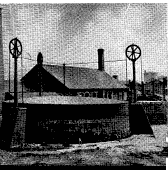
Matthew Boulton built the famous Soho Works for the production of metal wares. Boswell says of it: "I visited the great works of Mr. Boulton at a place which he has called Soho, about 2 miles from Birmingham, which the very ingenious proprietor showed me himself to the best advantage. I shall never forget Mr. Boulton’s expression to me: ‘I sell here, sir, what all the world desires to have— power’. He had about 700 people at work. I contemplated him as an iron chieftain, and he seemed to be ‘a father to his tribe’. One of them came to him complaining grievously of his landlord having distrained his goods. ‘Your landlord is in the right, Smith’, said Boulton, ‘but I will tell you what: find you a friend who will lay down one-half of your rent and I’ll lay down the other half and you shall have your goods again’."
The factory produced an amazing variety of goods, amongst which were buttons, buckles, boxes, trinkets, swords, hilts, gun furniture, tumblers, coffee pots, lamps, spurs, etc., etc.
Until Boulton met James Watt his machinery was driven by water power, but he devised mechanical contrivances to speed up production and save money. At this time a large amount of false coinage was being manufactured in the Birmingham district and was giving the town a nation-wide notoriety which Matthew Boulton determined to try to counteract. He devoted his energies with such zeal to this end that some 800,000 coins were struck each week in the Soho factory, and the copper coinage of the country was entirely reformed, for, with the abundant supply of good copper coins, the base ones could be detected quite easily. Boulton associated himself with every phase of Birmingham’s industrial life, and of him truly can it be said: "He will ever hold the loftiest place among the industrial heroes of the world and the greatest men of Birmingham".
James Watt
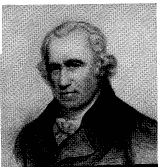
James Watt was a Scottish engineer. In 1764 he repaired a model of Newcomen’s steam engine and invented improvements. He was unable to commercialise his invention for lack of money until he met Boulton, whose partner he later became. Newcomen’s engine was used for pumping water out of mines but was so wasteful of coal and power that it used nearly as much coal as it helped to produce. Watt’s engine was a great improvement. His second engine had a rotary action and embodied the essential features of the modern steam engine; it could be used for driving machines. Thus it led the way for the whole Industrial Revolution. The engine was patented, and for 25 years the Soho Works (the forerunner of Avery’s) manufactured many kinds of engines for factories in all parts of the Kingdom and abroad.
William Murdoch
William Murdoch was another famous Soho workman, and, like Watt, a Scotsman by birth. He hoped because of this to be taken on by his fellow-countryman. At the time, however, Watt was away from Soho, and Murdoch was interviewed by the great Boulton himself, who always selected his workmen with the utmost care. He was not greatly impressed by the shy young stranger who twiddled nervously with his hat while talking to Boulton. The peculiar fabric of the said hat attracted
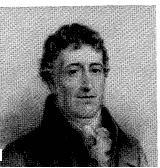
 Boulton’s attention, and he asked Murdoch of what it was made.
"Timmer, Sir", replied the boy. "Timmer? Do you mean to say
that it is made from wood?" "Yes, Sir." "Pray how was it
made?". "I turned it mysel’, sir, in a bit lathey of my own
making." Boulton looked keenly at the tall good-looking stranger and,
after a brief pause, told him to call again. So Murdoch began as an ordinary
mechanic. His inventive brain caused him to apply coal gas for lighting his
house, and it is for this invention that his name is chiefly remembered.
Murdoch died in 1839.
Boulton’s attention, and he asked Murdoch of what it was made.
"Timmer, Sir", replied the boy. "Timmer? Do you mean to say
that it is made from wood?" "Yes, Sir." "Pray how was it
made?". "I turned it mysel’, sir, in a bit lathey of my own
making." Boulton looked keenly at the tall good-looking stranger and,
after a brief pause, told him to call again. So Murdoch began as an ordinary
mechanic. His inventive brain caused him to apply coal gas for lighting his
house, and it is for this invention that his name is chiefly remembered.
Murdoch died in 1839.
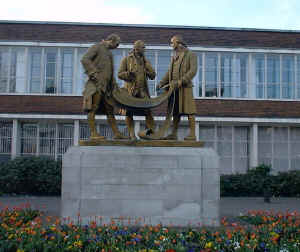
William Bloye's Sculpture of Boulton, Watt and Murdoch erected in 1956 infront of the Registery Office Broad Street


