
A brief history of Birmingham
BIRMINGHAM MEN IN THE EIGHTEENTH CENTURY
John Baskerville
A famous name in Birmingham’s industrial roll of honour is that of John Baskerville, the printer, of whom a contemporary, Derrick, says: "I need not remind you that Baskerville, one of the best printers in the world, was born in this town and resides near. His house stands at about half-a-mile distance on an eminence which commands a fine prospect. I paid him a visit and was received with great politeness though an entire stranger. His apartments are elegant, his staircase is peculiarly curious, and the room in which he dines and calls a smoking room is very handsome. The grate and furniture belonging to it are, I think, of wrought iron and cost urn a round sum. He has just completed an elegant octavo Common prayer Book, has a scheme for publishing a grand folio edition of the Bible, and will soon finish a beautiful collection of fables. He manufactures his own paper, types and ink, and they are remarkably good." The Bible referred to was Baskerville’s masterpiece. An original edition of John Freeth’s book,
The Political Songster, in the exact Form it left the Baskerville printing house, can be seen in the Birmingham Reference Library. John Baskerville died in 1775. An atheist he was buried in the conical base of a disused windmill in his own garden. Baskerville was disinterred when canal wharves, the New Wharves were built 1821, his remains transferred after some years to Christ Church catacombs (New Street/ Colmore Row) and on the church�s demolition 1893 reburied 1898 at the Church of England Cemetery Warstone Lane in a vault beneath the chapel which was demolished 1953 but with the catacombs intact.

Dr. Joseph Priestley
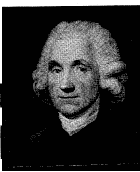
Dr. Priestley, the eminent scientist, was well known for his ‘brilliant series of discoveries", amongst which were oxygen, nitrogen, ammonia, and sulphuric acid. He came to Birmingham at the invitation of the congregation of the New Meeting House, Birmingham, one of the best-known Nonconformists’ Chapels in the country. His strong religious views, especially those on freedom and liberty which led him to declare openly in favour of the mob in the French Revolution, caused the Priestley Riots, when almost all his fellow dissenters lost their homes and property. The New Meeting House was razed to the ground, as was Priestley’s own house at Fair Hill. All his valuable books were scattered to the four winds; his laboratory was ransacked and its priceless instruments and apparatus smashed ruthlessly. The mob rioted for several days. There was no police force and the magistrates were quite unable to restore order, so soldiers were brought in. Realising this, the rioters dispersed in small bands and, although some of the ringleaders were rounded up later in outlying districts, the .majority escaped without punishment. After this, Priestley left Birmingham, and died in Pennsylvania in 1804.
John
Wyatt
A notable Birmingham man was John Wyatt, who long before Arkwright invented the "spinning jenny" made a spinning engine, which, in 1733, spun the first thread of cotton yarn ever produced by machinery.
In the Birmingham Reference Library are preserved the first two hanks of cotton Wyatt spun, with the following description written by the inventor himself: "The enclosed yarn, spun by the spinning machine (without hands) about the year 1744. The movement was at that time turned by two or more asses walking round an axis in a large warehouse near the wall in the Upper Priory in Birmingham" (because steam power had not yet been introduced). This invention did not bring Wyatt much success, and while imprisoned for debt "he was perfecting his plans for a machine for simplifying the weighing of heavy loads. That such a machine was needed will be apparent when we consider the amount of peculation that might be going on constantly in the supply of coal to the poor".
When completed there was great demand for Wyatt’s weighing machine, and he supplied the Corporations of Chester, Hereford, Gloucester, and many smaller places. When Wyatt died in 1766 he was buried in St. Philip’s Churchyard.
