
|
Hall Green History
a brief look at the past
|
|
Hall Green
was a small part of the ancient Parish of Yardley, which later
became Yardley Rural District. The
|
|
Sarehole Mill This is Birmingham's only working watermill. There has been a mill on the site since before 1542, with the 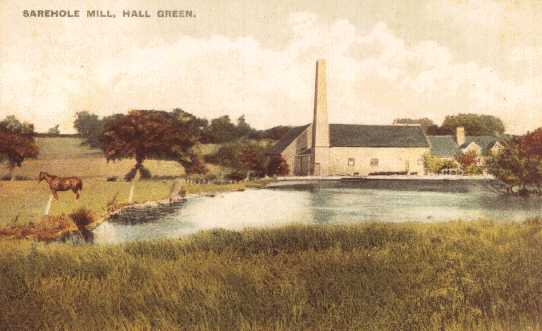 current builds dating back to the 18th century. Flour
was made here, and the mill was also used to roll and smooth metal
in the Industrial Revolution. The mill now houses a fine display
of Victorian rural life. The surrounding bogs and marshes provided
the inspiration for JRR Tolkien's Middle Earth land of magic and
monsters and it formed the basis of Hobbiton Village, home of the
Hobbits. Tolkien's family lived nearby at Wake Green Road
and Tolkien trespassed at the mill as a boy. The mill is
open from April to October. Entrance is free.
>Tolkien Trail
current builds dating back to the 18th century. Flour
was made here, and the mill was also used to roll and smooth metal
in the Industrial Revolution. The mill now houses a fine display
of Victorian rural life. The surrounding bogs and marshes provided
the inspiration for JRR Tolkien's Middle Earth land of magic and
monsters and it formed the basis of Hobbiton Village, home of the
Hobbits. Tolkien's family lived nearby at Wake Green Road
and Tolkien trespassed at the mill as a boy. The mill is
open from April to October. Entrance is free.
>Tolkien Trail
|
|
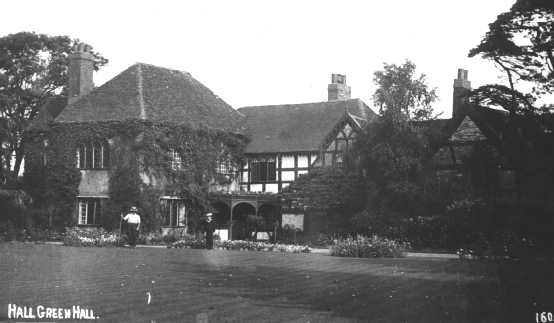
Hall Green Hall:
|
|
Churches: Just across from the Hall, Marston Chappell (now the Church of the Ascension) was built in 1703/4 across from Hall Green Hall. Here was the 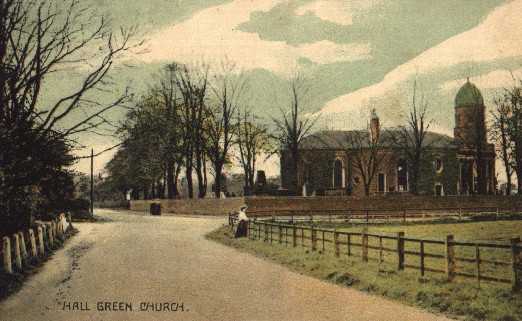 old centre of Hall Green, supplemented in late Victorian times
by a collection of houses known as the Hamlet. Hall Green has
lost this centre, and does not have one, unless the Stratford
Road is seen as a very elongated one!
old centre of Hall Green, supplemented in late Victorian times
by a collection of houses known as the Hamlet. Hall Green has
lost this centre, and does not have one, unless the Stratford
Road is seen as a very elongated one!A smaller C of E church was St Cadoc's in Highfield Road which was renamed St Peter's in 1954, burnt down in 1957 and was replaced in 1964 with a new church. Some other local churches are the Methodist in Reddings Lane (1924), the Trinity United Reformed in Etwall Road (1929), the Baptist on Stratford Road (1936), the Anglican/Methodist centre at Redstone Farm Road (1970), and St Ambrose Barlow R.C. on Lakey Lane (1981).
|
|
Highfield Hall: Highfield Hall in Highfield Road was originally  built around 1928 on land owned by Charles Lane as a pavilion for
the Gresham and Highfield Hard Court Tennis Clubs, but became very
popular before the War as a dancing studio owned by the Goodalls.
It was brick built with only one large room. During the war, it
was requisitioned to store flour or dried milk. In 1955 the site
was sold to the city council. Since 1980 Highfield Hall had been
used as a community centre and for adult education.
built around 1928 on land owned by Charles Lane as a pavilion for
the Gresham and Highfield Hard Court Tennis Clubs, but became very
popular before the War as a dancing studio owned by the Goodalls.
It was brick built with only one large room. During the war, it
was requisitioned to store flour or dried milk. In 1955 the site
was sold to the city council. Since 1980 Highfield Hall had been
used as a community centre and for adult education.
|


|
Rural Scene: One of the most attractive areas in the whole City is 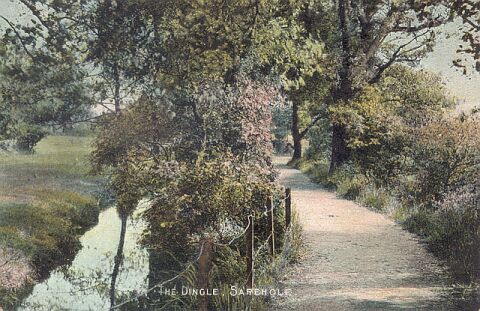 on the edge of Hall Green: the River Cole valley. The City has
kept faith with early plans to retain the valley as a green
corridor, and the River Cole and Chinn Brook Conservation Group
pursues this aim very effectively today. There is now a
continuous walkway from Solihull Lodge to the Ackers and beyond.
The Group argues for nature conservation, and also seeks the
preservation of old hedgerows, fragments of ancient woodland,
and other remnants of historic landscape. These 'time-slips' are
present in surprising places, and the Group tries to make local
people and the City authorities aware of them, and also to value
them.
on the edge of Hall Green: the River Cole valley. The City has
kept faith with early plans to retain the valley as a green
corridor, and the River Cole and Chinn Brook Conservation Group
pursues this aim very effectively today. There is now a
continuous walkway from Solihull Lodge to the Ackers and beyond.
The Group argues for nature conservation, and also seeks the
preservation of old hedgerows, fragments of ancient woodland,
and other remnants of historic landscape. These 'time-slips' are
present in surprising places, and the Group tries to make local
people and the City authorities aware of them, and also to value
them.
|
|
Housing: In Hall Green a high proportion of private housing was constructed, which tended to be built without the  grand sweeping planning characteristic of inter-war municipal
estates. Many were 'distinctive' homes built by Dare's. and
frequently green spaces were left enclosed behind the new roads.
A lot of money was spent on infrastructure by the city at this
time, which contributed to the creation of a high quality of
life in Hall Green. The only sizeable council estate was built
around the Pitmaston Road area.
grand sweeping planning characteristic of inter-war municipal
estates. Many were 'distinctive' homes built by Dare's. and
frequently green spaces were left enclosed behind the new roads.
A lot of money was spent on infrastructure by the city at this
time, which contributed to the creation of a high quality of
life in Hall Green. The only sizeable council estate was built
around the Pitmaston Road area.
|
|
Transport: The early years of the twentieth century brought change with rail passenger services starting in 1908, 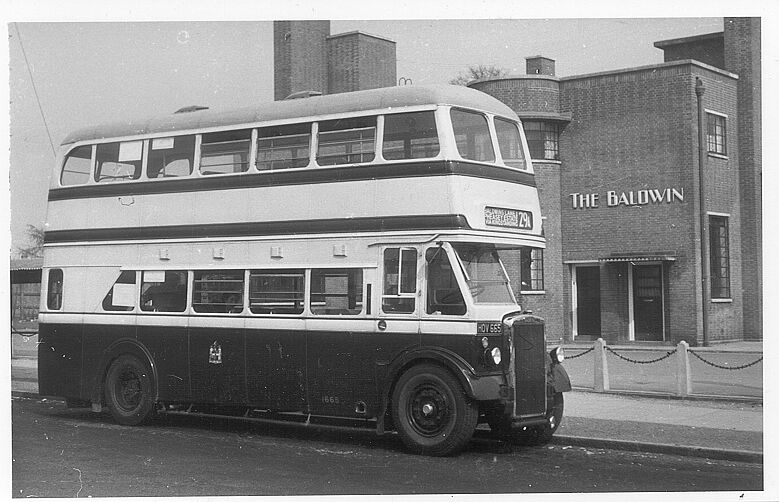 linking Hall Green and
Yardley Wood
to Birmingham and Stratford on Avon. In 1914 trams had crossed
the River Cole and ran on to the Bulls Head, then from 1928 on
to the City boundary. In 1928 the No. 29 bus service to
Kingstanding from Highfield Road also began, later with a
terminus at the Baldwin pub. The No. 11 outer circle bus route,
which started in 1926, cuts across the Stratford Road at the
junction of Colebank Road and School Road.
linking Hall Green and
Yardley Wood
to Birmingham and Stratford on Avon. In 1914 trams had crossed
the River Cole and ran on to the Bulls Head, then from 1928 on
to the City boundary. In 1928 the No. 29 bus service to
Kingstanding from Highfield Road also began, later with a
terminus at the Baldwin pub. The No. 11 outer circle bus route,
which started in 1926, cuts across the Stratford Road at the
junction of Colebank Road and School Road.
|
|
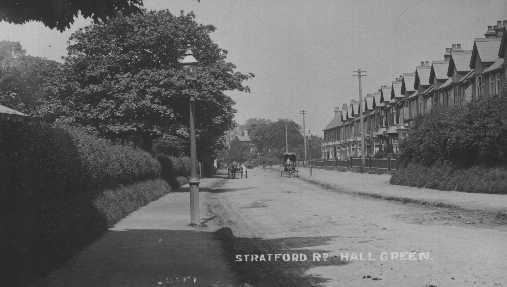
Roads: The main thoroughfare is the Birmingham to Stratford Road, entering as it crosses the river Cole at the  junction of Stratford Road and Shaftmoor Lane and leaving the area
past Robin Hood Island at the city boundary joining Shirley,
Solihull. It is crossed by the Outer Circle bus route, in the
north part, The Fox Hollies and Highfield Road junction at the
Bulls Head, and then Robin Hood Island at Solihull Lane. The
roundabout at Robin Hood was built in the early 1930s to replace a
rather complicated series of small islands. Trams ran through the
middle of the large island before they were replaced by buses.
Today traffic lights control the flow of vehicles and provide safe
pedestrian crossings across the busy Stratford Road. Robin Hood
has provided the inspiration for the names of several roads in the
area, such as Robin Hood Lane, Sherwood Road and Marian Way. 2004
sees the start of a new Red Route along the Stratford Road.
junction of Stratford Road and Shaftmoor Lane and leaving the area
past Robin Hood Island at the city boundary joining Shirley,
Solihull. It is crossed by the Outer Circle bus route, in the
north part, The Fox Hollies and Highfield Road junction at the
Bulls Head, and then Robin Hood Island at Solihull Lane. The
roundabout at Robin Hood was built in the early 1930s to replace a
rather complicated series of small islands. Trams ran through the
middle of the large island before they were replaced by buses.
Today traffic lights control the flow of vehicles and provide safe
pedestrian crossings across the busy Stratford Road. Robin Hood
has provided the inspiration for the names of several roads in the
area, such as Robin Hood Lane, Sherwood Road and Marian Way. 2004
sees the start of a new Red Route along the Stratford Road.
|
|
Cinemas: The first cinema in Hall Green was the Rialto Cinema, situated on the corner of Green Bank Avenue and 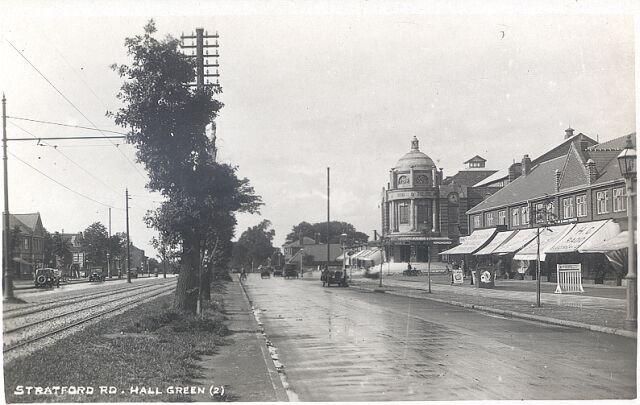 Stratford Road. It opened in October 1927 and closed in May 1959.
The site made way for a supermarket, now Somerfield. The same year
the the Rialto opened Robin Hood Cinema opened on the 26th of
December, it was then known as the Robin Hood Theatre. It stood on
the corner of Stratford Road and Ingestre Road. The Robin Hood was
a beautiful cinema with a gold dome, inside were gold settees
upholstered in red velvet, the passageways had Tudor decor and
over the screen was a scene depicting Robin Hood and his merry
men. It closed in March 1970: its final film performance was
"Zulu". It was soon demolished to make way for a
Waitrose Supermarket which opened in 1971 and still remains
today.
Stratford Road. It opened in October 1927 and closed in May 1959.
The site made way for a supermarket, now Somerfield. The same year
the the Rialto opened Robin Hood Cinema opened on the 26th of
December, it was then known as the Robin Hood Theatre. It stood on
the corner of Stratford Road and Ingestre Road. The Robin Hood was
a beautiful cinema with a gold dome, inside were gold settees
upholstered in red velvet, the passageways had Tudor decor and
over the screen was a scene depicting Robin Hood and his merry
men. It closed in March 1970: its final film performance was
"Zulu". It was soon demolished to make way for a
Waitrose Supermarket which opened in 1971 and still remains
today.
|
|
Pubs in Hall Green The pubs in the Hall Green area have not changed much over recent years but they have mostly survived the bulldozer unlike  those in other suburbs. On a journey down the Stratford Road the
College Arms stands at the corner of Shaftmoor Lane. Further down
just past the junction at School Road is the Horseshoes which now
has a "Wacky Warehouse" added to the rear of it. Next is
the
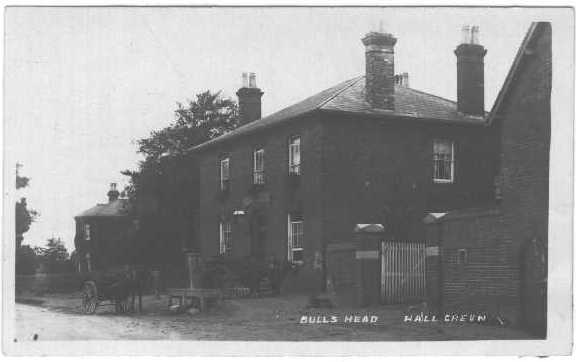
Bulls Head at
Highfield Road, built around 1840, then The Robin Hood by the
island with the same name. Sadly the name is now relegated to the
small print and replaced by the official name of "Toby
Carvery, Hall Green". At the rear of the pub is now a Holiday
Inn Express Hotel. An interesting thought is all these pubs along
the Stratford Road are all on the Southbound side. You can travel
from the Angel at Camp Hill to Shirley before finding the Saracens
Head on the other side of the road. Another pub still in
business is The York on the corner of Fox Hollies Road and York
Road.
those in other suburbs. On a journey down the Stratford Road the
College Arms stands at the corner of Shaftmoor Lane. Further down
just past the junction at School Road is the Horseshoes which now
has a "Wacky Warehouse" added to the rear of it. Next is
the
Bulls Head at
Highfield Road, built around 1840, then The Robin Hood by the
island with the same name. Sadly the name is now relegated to the
small print and replaced by the official name of "Toby
Carvery, Hall Green". At the rear of the pub is now a Holiday
Inn Express Hotel. An interesting thought is all these pubs along
the Stratford Road are all on the Southbound side. You can travel
from the Angel at Camp Hill to Shirley before finding the Saracens
Head on the other side of the road. Another pub still in
business is The York on the corner of Fox Hollies Road and York
Road.
Courtesy of Maxam Cards |
|
|
|
A Tale of Two Pubs: The Three Magpies in Shirley Road and its sister pub the Baldwin in Baldwins Lane were designed by Birmingham born Edwin Reynolds. The architects were Birmingham based Wood & Kendrick. A profile of the front elevation of the two pubs placed side by side would reveal another part of history as the design was based on The Queen Mary cruise liner launched by Cunard White Star on September 26th 1934, undertaking her maiden voyage on May 27th 1936. Fortunately, The Three Magpies and the Baldwin have stood the test of time a little better as The Queen Mary was decommissioned on October 5th 1971. After a recent refurbishment the Three Magpies has become The Maggies.
|
|
Sport: football Moor Green were formed in 1901 when the players of Moseley Ashfield Cricket Club decided 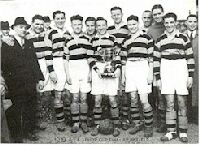 to amuse themselves during the winter by playing football. The
first ground was on a part of a farm in Moor Green Lane,
Moseley, but when the rent was increased from �2 after one
season the club was forced to move on.
A number of grounds were rented until 1930 when the current
site in Sherwood Road was acquired. The ground was named
�The Moorlands� and was soon developed into one of the
best stadiums in the Midlands, but in the 1980s, safety
regulations and planning requirements enforced the
demolition of several banks of terracing and the pitch had
to be turned through 90 degrees to make way for increased
car parking.
Moor Green
are now members of the Dr Martens (Southern) Football League
Premier Division
to amuse themselves during the winter by playing football. The
first ground was on a part of a farm in Moor Green Lane,
Moseley, but when the rent was increased from �2 after one
season the club was forced to move on.
A number of grounds were rented until 1930 when the current
site in Sherwood Road was acquired. The ground was named
�The Moorlands� and was soon developed into one of the
best stadiums in the Midlands, but in the 1980s, safety
regulations and planning requirements enforced the
demolition of several banks of terracing and the pitch had
to be turned through 90 degrees to make way for increased
car parking.
Moor Green
are now members of the Dr Martens (Southern) Football League
Premier Division
|
|
|
Sport: Greyhound Racing Hall Green Stadium opened its doors to greyhound racing in August 1927. In 1928 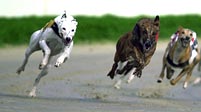 motorcycle
speedway racing started, on a circuit inside the dog track.
Local residents signed a petition against the speedway and it
finally finished when the Second World War started and later a
football pitch was made in the centre area. The Stadium has been the subject of considerable investment over the
years with two restaurants for around 500 diners, bars and
fast food facilities. In October 1990
Hall Green Stadium
opened its own Motel, situated adjacent to the third and
fourth bends. Another addition has been a snooker hall, which
is along the back straight of the track. motorcycle
speedway racing started, on a circuit inside the dog track.
Local residents signed a petition against the speedway and it
finally finished when the Second World War started and later a
football pitch was made in the centre area. The Stadium has been the subject of considerable investment over the
years with two restaurants for around 500 diners, bars and
fast food facilities. In October 1990
Hall Green Stadium
opened its own Motel, situated adjacent to the third and
fourth bends. Another addition has been a snooker hall, which
is along the back straight of the track.
|
|
|
Industrial Past Hall Green has an interesting industrial past. This is not just a matter of smithies and of mills, some of which ground blades or rolled metal. Some of 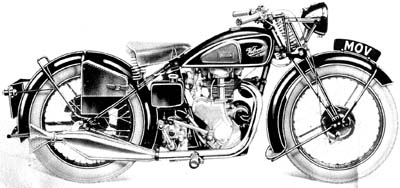 the more recent industrial activity was also there before the
houses. Early Ordnance Survey maps show a small building in
the fields, known as the Robin Hood Works. This became Newey
Goodman, manufactures of 'smallwares', employing over a
thousand people. A small chocolate factory appeared before the
First World War at Webb Lane, which later made electric
vehicles and fork lift trucks in particular. Aldis Brothers
built a factory on a green field site in 1914 at Sarehole
Road, and made world famous signalling lamps. One of the great
names in British motorcycling:
Velocette
was at York Road on the site that is now
Goodrich
Engine Control Systems (formerly Lucas Aerospace)
the more recent industrial activity was also there before the
houses. Early Ordnance Survey maps show a small building in
the fields, known as the Robin Hood Works. This became Newey
Goodman, manufactures of 'smallwares', employing over a
thousand people. A small chocolate factory appeared before the
First World War at Webb Lane, which later made electric
vehicles and fork lift trucks in particular. Aldis Brothers
built a factory on a green field site in 1914 at Sarehole
Road, and made world famous signalling lamps. One of the great
names in British motorcycling:
Velocette
was at York Road on the site that is now
Goodrich
Engine Control Systems (formerly Lucas Aerospace) |
|
|
Famous names: |
|




 Hall Green Michael Byrne |
Books about Hall Green:
Tempus Publishing have published a book about
Hall Green compiled by Michael Byrne, which contains over 200 old photographs of Hall Green. It
costs �9.99 and is available online from
Amazon
|
|
|
|