
A brief history of Birmingham
First Market
In 1166, Peter de Bermingham, the Lord of the Manor of Berm, was granted a charter to hold a weekly market every Thursday, and permission to levy tolls on goods and produce sold therein. In 1251, the privilege of holding an annual fair of four days, beginning on Holy Thursday, was secured for the Manor of Birmingham. These institutions flourished because Birmingham stood on the River Rea at the only good crossing in the district, and thus it was a natural centre where the trackways (for there were no proper roads) came together. Craftsmen and traders naturally began to settle in Birmingham to be near the market.
Free Trade and its Advantages
As Birmingham was a manor and not a town, there were no irksome restrictions to be observed by the craftsmen—smiths, tanners, and gun-smiths—through the Middle Ages. They were free to exhibit and sell their goods unhindered, the same privileges being enjoyed by those who journeyed to the increasingly thriving town for the purpose of trade. This freedom encouraged men of enterprise and ambition living in the neighbourhood to come into Birmingham, where they were allowed to work undisturbed, and compete with all comers. So the town flourished and grew during the fourteenth and fifteenth centuries.
-
Birmingham was granted city status in January 1889
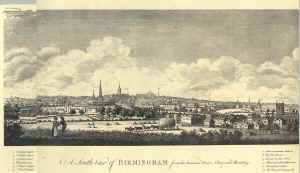
A South view of Birmingham from the Summer House, Cheapside Bordesley
Image from An History of Birmingham by William Hutton

