Birmingham's Heritage and Attractions

|
|
|
Birmingham Town Hall
Designed by the architect Hansom, who also designed the Hansom cab. Work started in 1832 and the Town Hall was opened on September 19, 1834 although it was not finished properly until 1849 and the later stages of its construction were carried out under the direction of the architect, Charles Edge. It opened its doors not only for renowned classical composers such as Mendelssohn and Elgar but also for leading jazz musicians and pop groups. The Town Hall is now undergoing major renovation work which will take a number of years to complete. > Pride of Brum by Carl Chinn
|

|

|
Hall of Memory
Birmingham's Hall of Memory was erected in the 1920s to commemorate the 12,320 Birmingham citizens who died in the "Great War", which we now know as the First World War (a further 35,000 Birmingham men came home from that war with a disability). The Hall, made form Portland Stone, from Portland Bill, near Weymouth, was opened by Prince Arthur of Connaught on July 4, 1925. It cost �60,000, which was raised by public subscription.
|
|
|
|
|
Council House
Built between 1874 and 1879 on what was once Ann Street, and
designed by Yeoville Thomason, the Council House is now a Grade II
listed building, used for all Council and most Committee meetings.
The front, facing Victoria Square, has a pediment showing Britannia
receiving the manufacturers of Birmingham. |
|
|
|
|
|
|
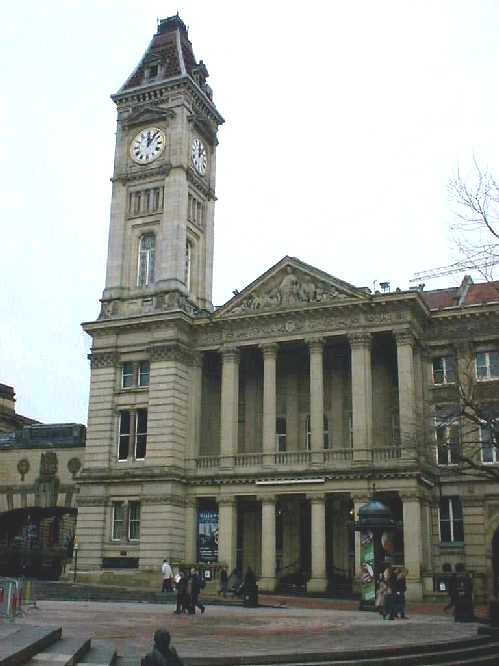
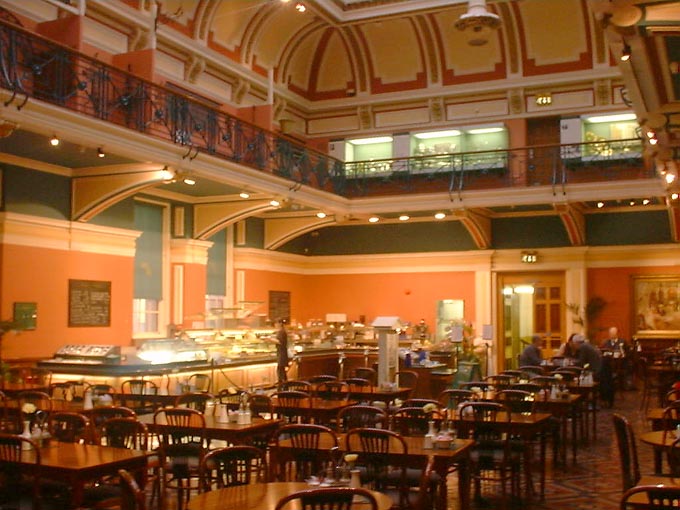
Birmingham
Museum and Art Gallery
Outstanding collection of pre-Raphaelite and other paintings,
silverware, sculpture, metalwares, glass, ceramics, wooden objects,
ethnographical, archaeological and natural history collections, and
the Light on Science interactive gallery. |
| Note: The Science Museum in Newhall Street is closed. Discovery Centre at Millennium Point in Digbeth, and is now open as world-class museum of science, technology and heritage. |
|
|
|
|

|
Former Head Post Office Victoria Square The French renaissance style building was built in 1891 to the design of Sir Henry Tanner, it served for many years as the head post office for Birmingham and later as the head office of the TSB bank. With three main floors and two further attic floors the building is tastefully decorated with Corinthian style pilasters and pillars, stone urns and above two of the attic windows, two lantern shaped domes. A round domed tower to the left of Victoria Square facade adds interest to a building that might have been demolished in 1973 had it not been for the intervention of the Birmingham Victorian Society. |
|
|
|
|
Baskerville House Centenary Square Baskerville House was designed by T Cecil Howit, and built in 1939. Once a city administrative centre, it is to be redeveloped as a hotel. Most notable is the full height entrance porch with a pair of Ionic columns surmounted by roof level semicircular arch, The sides of the building boast similar Ionic columns. |

|