
Birmingham Trail, ONE.
Birmingham Civic and Commercial Buildings.
We start our walk at the portico of
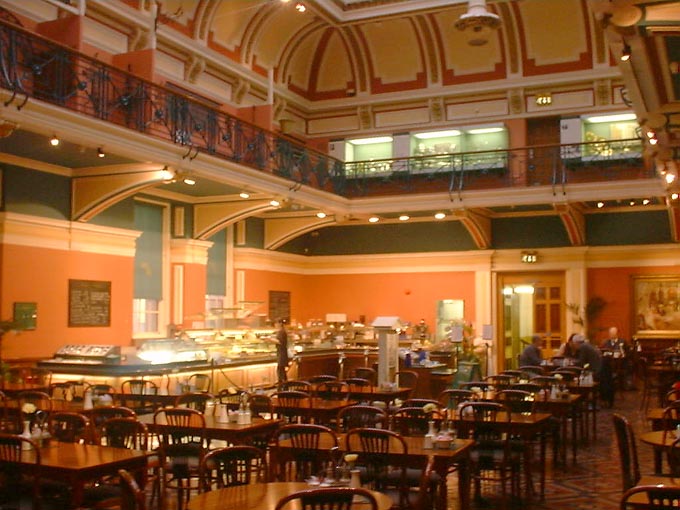
Birmingham Museum and Art Gallery,listed Grade II*, 1884-9, Chamberlain Square, by H.R.YeovilleThomason. This bold, classical styled establishment was built from the profits of the Municipal Gas Dept., the stone in the entrance hall carrying the words, "By the gains of Industry we promote Art". The Art Gallery is well worth a visit and renowned for its fine collection of Pre-Raphaelite paintings which includes Ford Maddox Brown�s "The Last of England". There are also masterpieces by Edward Burne Jones, Holman Hunt, John Millais and Dante Gabriel Rossetti, many donated by Birmingham businessmen and Civic leaders. A fresco, by Joseph E. Southall, a member of the "Birmingham School", (a group of artists and craftsmen who formed themselves into the Birmingham Guild of Handicraft at the beginning of the 20thC), is situated at the head of the staircase, and depicts Corporation Street in 1914. The Industrial Gallery, one of the best visible examples of a High Victorian iron and glass exhibition room, (obscured by false ceilings and converted into offices and store rooms in the 1950�s) was restored in 1985, to celebrate the Museum�s Centenary. The original galleries were re-furbished and filled with displays of Applied Art, appropriate to the Industrial Gallery�s first function. This is very attractive, as is the Edwardian Tea Room. The tall clock tower is known as "Big Brum" and built as an expression of civic pride. Chamberlain Square was originally the heart of Victorian Birmingham and was enclosed by Mason College, the Liberal Club and the Public Library, now all demolished. All that remains is the Chamberlain Memorial Grade II* of 1880, designed in a Venetian G Gothic style by John Henry Chamberlain (no relation) t to commemorate the public services of Joseph h Chamberlain, mayor of Birmingham who was then to b become a Birmingham M.P. and later Colonial e Secretary, who was only 44 years at the time, and h whose head is depicted at the fountain head, by T Thomas Woolner, the Pre-Raphaelite sculptor. On h the steps behind the Town Hall is



The Statue of Thomas Attwood, a little known but important leader, and one of the first two M. Ps representing Birmingham after the Reform Bill of 1832, a believer in monetary reform and a supporter of the ideals of the Chartists. The Town Hall Grade I, and designed by Joseph Hansom of Hansom cab fame, and Edward Welch and started in 1832. Modelled on the Temple of Castor and Pollux in the Roman Forum, the Corinthian peristyle is of pure classical architecture. It is constructed in brick and faced in Anglesey marble and set on a rusticated podium. By 1834, the architects were declared bankrupt, and Charles Edge, the architect of the Market Hall, supervised the completion. The interior is of the Georgian assembly room type with a towering organ by Hill, decorated by J.H. Chamberlain in1880. The original neo-Greek details were altered in 1927 when a new gallery was added. In the 1880s, the architects, Martin & Chamberlain, enlarged the entrance, and the front podium has recently been glazed. Mendelssohn�s "Elijah" and Elgar�s "Dream of Gerontius", were first performed here. There are plans to restore the building to the original designs and at the time of writing it is empty and there is no access available at present. The Council House, listed Grade II*, built in 1874-9 by H.R.Yeoville Thomason adjoins the Art Gallery and faces Victoria Square. Following a competition, the winning design was chosen by Alfred Waterhouse. It is in a Renaissance style with a rusticated base, portico and a central dome. The main facade has a mosaic by Salviati, who executed the mosaic on the Albert Memorial in London, (the sculpture by Lockwood, Bowton & Sons) portraying Britannia rewarding the manufacturers of Birmingham. A fine staircase rises under the slightly Moorish styled dome to a suite of grand reception rooms overlooking a statue of Queen Victoria by Thomas Brock R.A. unveiled in 1901. Queen�s College Chambers listed Grade II is a 1904 re-fronting by Mansell and Mansell in Gothic buff terracotta and brick, now grafted onto an office block. Queen�s College grew out of a school of medicine and surgery, founded in 1825, was transferred to Mason College, and developed into Birmingham University. The new steps and pool in Victoria Square, with statuary are by Dhruva Mistry and were installed in 1992. The Iron Man by Anthony Gormley is 20 feet tall and presented to the City 1993 by the T.S.B. after a public competition. 1, Victoria Square, Grade II, was built in 1891, by Sir Henry Tanner. This French Renaissance styled building, until recently the T.S.B. Headquarters was originally Birmingham�s Head Post Office. Threatened by demolition in the early 70s, it was saved by the Victorian Society in 1978, although the parcels and sorting offices were demolished. New St. When New St. was new we do not know, but it was laid out and the open-field strips converted into burgage plots, in medieval times. In 1848, L & NWR decided to build New St. Station on the south side of New St. and at the same time agreed to allow Midland Railway trains to use it. Seven acres of slums were demolished to provide space for it. In the last two decades of the 19thC. New St. was largely rebuilt and over 100 years later it has become a pedestrian street. The City have now introduced a policy to improve this elegant Victorian street. On the right hand side are,


Nos. 80. 81, 82, Grade II on the corner towards Pinfold St. is a mid 19thC Venetian Gothic styled building of four storeys in red brick. Recently restored, the elevations show pilasters, segment headed windows and an elaborately bracketed cornice. The buildings behind the facade are gutted. Nos. 84, 85 & 86 and 88, 89 and 90 Grade II, are all four storeyed, re-furbished facades with new building behind. Nos. 92 & 93 New St. and 2-5, Ethel St. Grade II, late 19thC, stuccoed, three storeys of classical style. Opposite is the entrance to the present galleries of The Royal Birmingham Society of Art. Just inside, the main staircase I is flanked with the lists of the names of all the past m members of the Society and those of the illustrious V Victorian artists who have served as honorary r Presidents since 1842. Among them you will find J John Everett, Millais, Holman Hunt, Edward B Burne-Jones, Frederick Leighton, George Watts, L Lawrence Alma-Tadema, Edward Poynter Frank B Brangwyn, Charles Eastlake, Joseph Southall and A Arthur Gaskin. Architects such as J.A. Chatwin, o John Henry Chamberlain, W. H. Bidlake and Charles Bateman etc. are also listed. This Society, founded in 1814, has a fine history, having a new exhibition building by Thomas Rickman and an inaugural opening in 1829, and a Royal title in 1868. For many years exhibitions at the RBSA were regarded as being second only to the Royal Academy. Unfortunately, the lease expired and the original circular gallery and the columned portico across the pavement in New St. disappeared in the early years of the 20th C. The building was pulled down, and the site re-developed with a small gallery built on the first floor. The City lost a distinctive landmark and a major cultural institution although it is still worth visiting when an exhibition is in progress. Opposite is The Piccadilly Arcade, by Nicol & Nicol, was originally built as a Picture House, reportedly the first of Birmingham�s cinemas. It opened in 1910 and was converted into an arcade in 1926. The slope of the original building still survives as do the original shop fronts and a brass handrail.


No. 44 Temple Row West, Birmingham Midshires Building Society, Grade II*, originally Ocean Assurance, is late 19thC. by Mansell & Mansell. This is a fine office block in the late Flemish Gothic style, with well detailed red brick and buff terracotta elevations. Note the classical shells and Flemish gables of the Early Renaissance upper storey. Portman Building Society built in the 1880s is a classical styled office block with arched windows, stucco and rusticated ground floor, which has been mutilated. Fuller�s Old Joint Stock Wine Bar, formerly Lloyds Bank, and originally Birmingham Joint Stock Bank Grade II, was built in 1862-4 by J.A.Chatwin. The height of this building destroyed the original regularity of Temple Row West of the 1820s, being entirely out of scale. The two unequally proportioned storeys provided a ground floor banking hall of some grandeur and originally, the two stories of columns supported a fine line of urns. No. 3 Temple Row, is a classically styled house with Corinthian columns and was probably lived in by Samuel Lines, the Birmingham artist, who was buried beneath the Egyptian styled monument opposite in 1863. The Church of St. Philip, becoming Birmingham Cathedral, in 1905, a Grade I listed building, well worth a visit, was completed in the early 18thC. and designed in the style of English Baroque. The concave sides of the tower and the unexpected details round the west door-cases are its most striking Baroque motifs. The architect was Thomas Archer, a Warwickshire man, who was influenced by Sir Christopher Wren and studied the works of Bernini and Borromini. It was refaced in 1864/9, and extended in 1883-4 by J.A.Chatwin, another local architect and a pupil of Sir Charles Barry 1851/3. The original shallow apse was replaced by a chancel and Archer�s full-height pilasters were continued by Chatwin on the inside walls by free standing Corinthian columns. The interior is beautifully decorated and the four magnificent stained glass windows, The Nativity, The Crucifixion, The Ascension, and The Last Judgement, dating from 1884-97 were designed by Sir Edward Burne-Jones (who was christened here and lived near here as a boy) and were constructed by Morris and Co.


Now return to the Art Gallery, visit the Edwardian tea-room, and look at the collections.