
Back to back Smiles
By Carl Chinn
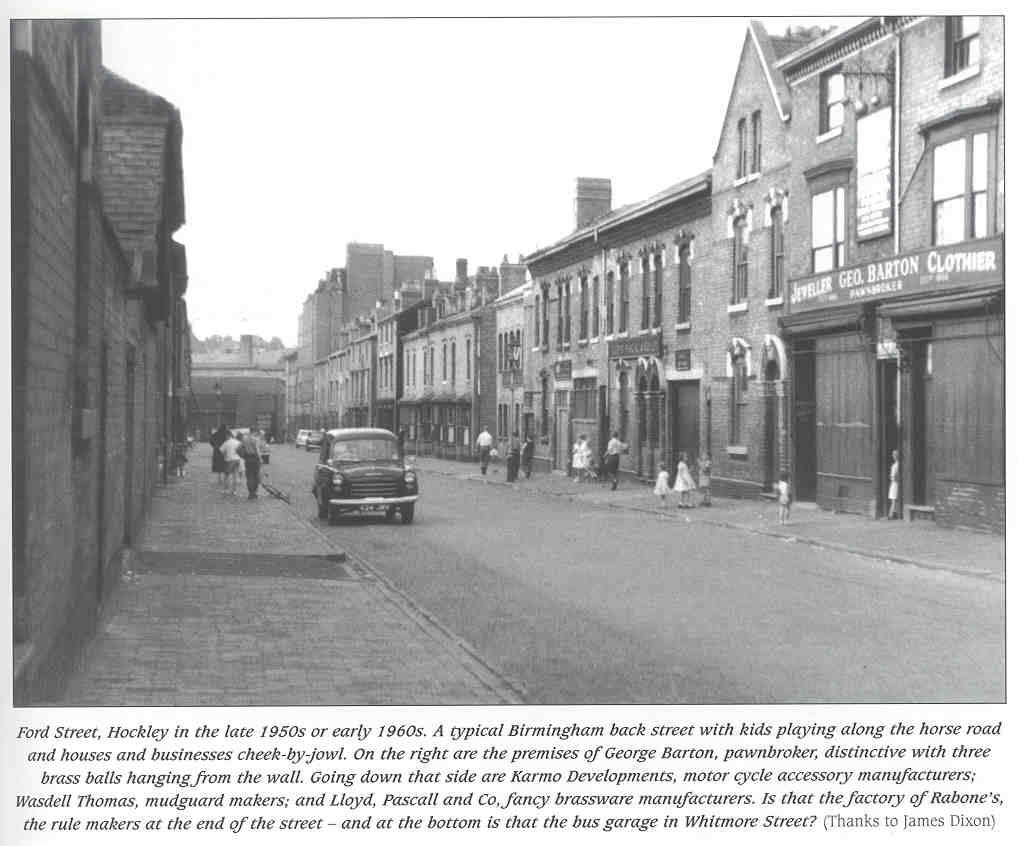
| A throng of short streets strikes out from the main drag. Each has a different name, but all of them are the same. They are dark, noisy and pungent. Smoke belches out of countless chimneys, sounds clamour from every direction and smells waft upwards from innumerable buildings. There is so little space and yet so many people pour into such a small area. They've been pulled in by industry and they're held fast by work, familiarity, neighbours and kin. Some of them live in front and back houses - they've got two rooms downstairs - but most crowd into the hundreds and hundreds of back-to-backs. | |||
|
Lathes, horse's hair and plaster. It's not surprising that stinking bugs, slithery silver fish, vile black bats and other foul vermin infest the houses - no matter how hard the women graft to keep them clean. And when a new babby is born, the crib is made up from one of the drawers, or else from an orange box from the local greengrocer. |
|
||
| Downstairs, there's a pokey scullery filled with just a sink and a couple of shelves, and there's one main room. This does for almost everything. With the big black range, it's a kitchen. With a table and chairs, it's a dining room. And with its squab, it's a living room. For mothers it's also a work room. Here they iron and clean. If they're poor, it's here that they work on carding buttons and hooks and eyes, at chopping up and bundling firewood, and at a multitude of other hard and weary tasks to stave off hunger. | |||
|
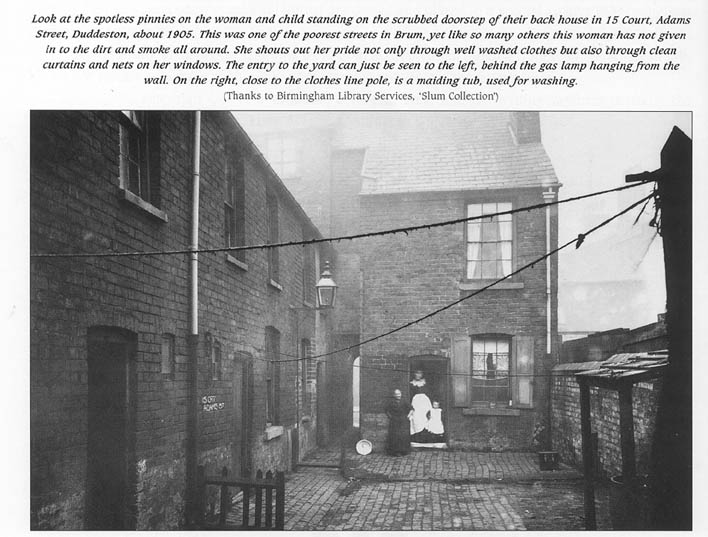
Some back-to-backs front on to the street itself, but most are approached up a tight and low entry which leads into a yard. This has a number of communal facilities; there's a brew'us in which the women do the washing; there's the miskins where the rubbish is put; there are two or three lavatories shared between six or more families. And, until the late 1930s, there's a tap which supplies water for all the folk who live in the yard. | ||
| Strangers shrink from the areas which are packed with back-to-backs. They see them as dreary places, rocking with noises and polluted by the whiff of gas, steam and horse manure. They're right. The outlook is gloomy. it's loud and the atmosphere is filled with stenches. But they miss something. Here, where the environment is so hostile, there are people bonding together, Here where there are slums, there are neighbourhoods. No-one can mourn the destruction of insanitary, decrepit back-to-backs. But in sweeping away the back-to-backs, we failed to see the kids who played safely on the streets, the women who laid out the dead, who brought babies into the world and who had remedies. The back-to-backs of Brum may have gone - but the Brummies who lived in them still have something to teach us about living together. | |||
|
|
|||
|
|
|||
Reproduced from Our Brum Vol 2 by kind permission of
Carl Chinn
The Department of Modern History,
The University of Birmingham,
B15 2TT

Dr Carl Chinn MBE is a passionate Brummie born and bred. He is a Lecturer in Modern History at the University of Birmingham. He is a Radio Presenter with shows on weekday afternoons and Sunday Lunchtime on BBC Radio WM. Carl also the author of many books about Brum and has a new monthly magazine published called "Brummagem"