|
Memories of Brooklands Road Hall Green
By Philip Whitehouse
|
-
BACKGROUND
My mother was born Marjorie May HOWELLS but was known as
"Madge" throughout her life. As her maiden name might
indicate she was born of Welsh parents in Hockley; her parents
having eloped to Birmingham (well- where else?) from Newport
following family difficulties.
|
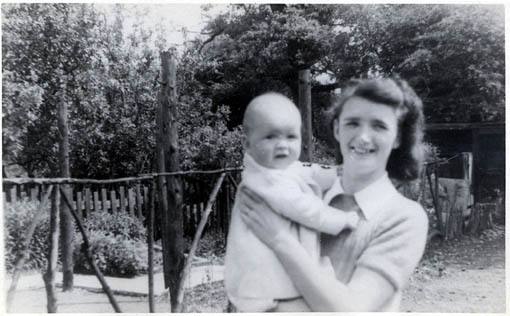
Mother and baby taken VE Day,
May 8th.1945 in the garden at
152 Brooklands Road
|
-
Madge grew up in Yardley Wood, attending Yardley Grammar School.
It was while attending Christ Church, Yardley Wood that she met
Maurice Whitehouse and they were married in June 1939.
The Birmingham pedigree of the WHITEHOUSE name is, of course,
quite impeccable. My father was a King's Heath man who attended
King's Norton Grammar School and was, at one time, manager of the
erstwhile
Gaiety Cinema in the city.
|
-
THE INTERVIEW
The following is an edited version of an Oral History Assignment
submitted to The School of Social Sciences, Deakin University,
Geelong, Australia in 1982.
The subject is the wartime experiences of Mrs M.
M."Madge" Whitehouse, the interviewer was her son,
Philip Whitehouse.
|
-
PREAMBLE
Hall Green is a residential suburb lying five miles Southeast of
the city of Birmingham. The City of Coventry lies some sixteen
miles to the East. Wolverhampton sixteen miles to the North West,
and Stratford-Upon-Avon, fifteen miles to the South. Brooklands
Road was (and still is) a tree-lined suburban street with houses
on both sides of the road possessing gardens to the front and
rear. The dwellings are all of two stories built of cavity-brick
construction with tiles roofs. The area opposite No.152 Brooklands
Road in 1939 was a fenced-off vacant area that served as a car
park for the nearby dog-racing stadium. (The homes of Silverlands
Close now occupy this site)
|
-
THE INTERVIEW
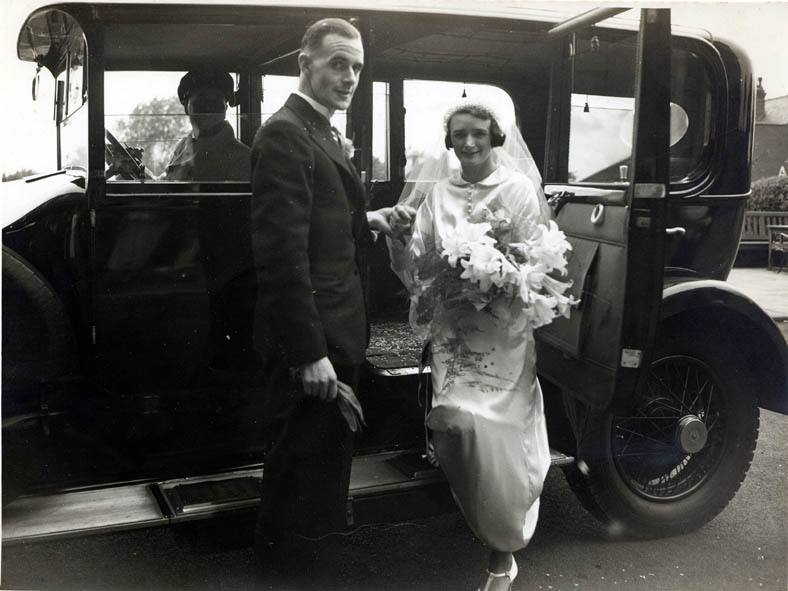
The marriage was celebrated according to the rites of the Church
of England at Christchurch, Yardley Wood. "A Pretty Wedding", as
the Birmingham Evening Standard Described it, solemnising as it
did the joining-together of Mr. Maurice Edward Whitehouse,
employee of Associated British Cinemas (A.B.C), and soon to be
manager of
The Gaiety Cinema in the City of Birmingham, with Miss
Marjorie May Howells, presently secretary to Mr Charles
Wainwright, Chief Technical Officer at Bakelite Ltd.
|
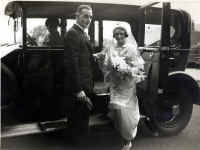
A wedding photograph
Yardley Wood, June, 1939
|
It was June 1939.
"We moved in October, 1939 to Brooklands Road, Hall Green. We
had a choice of another house close-by or no.152. For us it was
lucky we chose the latter. Maurice had been laid-off upon the
outbreak of war as all places of entertainment were immediately
closed: - but was reinstated a week later as it was decided that
Cinemas were needed after all. His employers A.B.C, nominated
him for attendance at the "Military Hardships Committee" as they
were unable to replace him at short notice. The upshot was that
his enlistment was deferred until September, 1940. Sure enough,
on the 18th.September 1940, off he went. I was alone, newly
married. We had been trying to make a home together: now it was
deferred for the duration. Fortunately, I was surrounded by good
friends and neighbours, friends with whom I have kept in contact
with ever since".
|
An example was next-door No.150, home of the Beasley family. Mr
Horace Beasley was a man of considerable resource and foresight.
After the Munich crisis he had seen which way things were going
and had built a superb Air-raid shelter with a reinforced concrete
roof. The interior was fully equipped with bunks and cooking
facilities.
"They insisted I joined them during the raids we knew would
come. This was lucky because, as our income before the war had
been over five pounds-a-week, we didn't qualify for a
pre-fabricated Anderson Shelter which people used to bury in
their gardens".
Some opinions of leading political personalities of the period:
Adolf Hitler?
"We just thought he was nuts- completely mad, that's
all"
|
Neville Chamberlain?
"Weak, ineffectual, doddering, we now realized that all he'd
done at Munich was to buy us time, the ultimate result was just
the same. We were bound to come to war. He did buy us that year.
But then I was probably biased because I was not of his
political persuasion".
(The Chamberlain family had strong associations with the City of
Birmingham, particularly Neville's father, Joseph, who was an
outstanding Lord Mayor before entering national politics. He is
remembered in an Australian context as, when Colonial Secretary,
he actively encouraged the federation of the Australian
Colonies).
Winston Churchill?
"Old windbag! The right man in the right place at the right time,
but that time doesn't very often come, which is why he was in the
political wilderness during the thirties and why the electorate
got rid of him as soon as possible after the war. He was good for
what he was doing for the General Public. He had the right spirit
and was able to inspire the right spirit ".
|
Any others- Anthony Eden?
(Affectedly)
"Oh frightfully, frightfully naice!! No. Churchill dominated. We
knew the others by name of course, but politics weren't so
important then. We had a coalition. Democracy in war- what's
that? We'll worry about politics after the war's won. A lot of
people thought that the coalition government was a good thing-
pity we didn't always have one.
The family financial situation.
"I was in a well-paid secretarial job which, had I still lived
with my parents
(The Howells family, Lewis Road, Hazelwell)
would have been good. But I kept the house going, rates and so
forth. No, it was a bit of a struggle, but then there was little
to buy anyway- clothes? - good clothes just weren't available-
unless you could get hold of a parachute- pure silk ".
|
Hall Green's geographical position was such that German bombers
would circle directly overhead before attacking Birmingham or
Coventry.
"I used to stand in the garden with Horace Beasley and he would
identify the aircraft overhead, Dorniers, Heinkels and Junkers.
You could identify the German 'planes by the throbbing sounds of
their engines"
(This effect was caused by deliberate de-synchronization of the
engines in a ploy to foil the British Sound-Ranging apparatus).
Reference to diary:
"The night of November 14th. A vivid glow in the eastern sky.
Coventry is catching it tonight ".
"I went to see Maurice with the army on the east coast on the
22nd.November and came back on the 25th. There had been a bad
raid. Bakelite had been bombed and a Delayed Action Bomb had
landed in the garden two doors up from home (No.148?)
The whole area had been evacuated. I was so taken aback. I was
thinking of all our treasures in the house and how I was going
to get at them. There was a policeman on guard there and I
begged him to be allowed to go in. After a lot of persuasion he
finally said I could go in- but at my own risk. I shot into the
house, looked around and thought what can I take that is most
important. And do you know what I took? All I could think of was
a writing pad to write and tell Maurice what had happened! Isn't
that absurd? My mind had gone a complete blank- I could have
bought a writing pad anyway!"
"Several houses in the road had been destroyed during this
particular raid; one of which was the house that we very nearly
bought instead of No.152. The family in it were all killed
".
"There was a very bad raid on 11th-12th.December This time I
was actually in the house when another Delayed Action Bob
exploded close-by. I suppose that they had not had time to
evacuate the area and you just had to take your chances. It
exploded and the whole house seemed to pick itself up, shake
itself, and settle again. No great damage apart from the usual
broken windows and lost tiles"
|
Consults diary.
" No water that was the 12th and on the 13th- still no water.
They brought it around in carts and you used to fill buckets
from it. The Birmingham Civil Authorities performed very well.
Don't forget there wasn't a street that hadn't caught it in some
way, and remember that the rescue teams were all people who had
regular jobs. They were working in what would now be called
'their own time'"
|
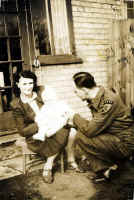
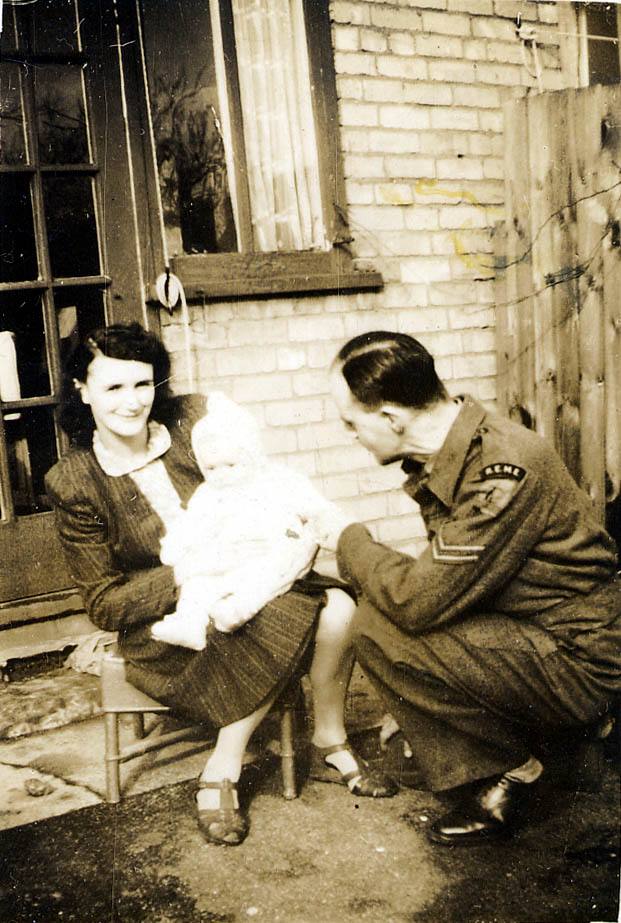
"Home on Leave"
|
Directly across the road from no.152 was what was then a carpark.
In 1940 it became a Barrage Balloon site manned at first by RAF
personnel who were later replaced by female members. Their orders
were to seek shelter with the civilians when the sirens sounded.
So, on many occasions there was the apparent anomaly of uniformed
service personnel safe in shelters whilst civilians whose places
they had taken were outside fighting fires and rescuing trapped
victims.
|
"Bakelite was working three shifts around-the-clock, throughout
the war. I worked during office hours and then cycled home the
three miles from Tyseley home. On two nights a week I was
rostered for fore-watching duties. We worked in teams of three,
one aiming the hose, one pumping away at the stirrup pump while
the third sought to replenish the bucket-where possible. The
incendiary bombs used to fall like hailstones burning everything
in the way. Typically, at one fire we attended, a bomb had burnt
in a straight line through the roof, through the bedroom
ceiling, through the eiderdown, the bed itself, through the
bedroom floor, into the Dining room below. This particular house
was unoccupied at the time. The owners were 'yellow bellies',
people who owned places in the country to which they retired to
get a night's sleep: leaving others to protect their
property.
This was the problem- lack of sleep- and it had a cumulative
effect. When not fire watching I would retire with the Beasley's
to the shelter. I took up smoking to try to relax! We were not
afraid, just horribly tired. We were able to distinguish gunfire
from bombs- there was a battery quite close- doesn't know if
they ever hit anything! The morning after the all-clear, the
intense smell of gas from broken gas mains. Of course you
couldn't light a match! I can never cook on a gas stove without
the smell of gas taking me back.
Then back to work. Lunch at the Works Canteen: - institutional
food but very acceptable- without it I would have been very
badly off ".
|
(Copies of weekly grocery orders from the order book � tendered
to the Birmingham Cooperative Society No.99 Grocery Branch, The
Parade, and Stratford Road are submitted to give an idea of what
that actually mean.
"The Black Market? -I never had enough money to indulge. Oh,
yes, it existed! If you had money you could get stuff.
Food parcels from Australia! Whole Apricots in Apricot jam!
Jellies, things we couldn't get anymore. Wonderful!
The Beasleys used to entertain overseas servicemen on leave.
The Australians were especially popular, the Canadians and,
particularly the Poles. The Americans? - They were likeable
individually but collectively: you'd see a gang of them and
think' bloody yanks!'
Entertainment? The radio kept us informed. We would never miss
'Lord Haw Haw' (William Joyce, executed as a traitor in 1946)
with his 'JARMANY CALLING".
We listed to the BBC news (Alvar Liddell) and thought the truth
actually lay somewhere between the two accounts. ENSA used to
sponser concerts at Bakelite for the workers. There were also
special concerts at Birmingham Town Hall: really top
orchestras".
|
Consults diary
"June 6th.1944, saw 'The Way Ahead' (David Niven) at 'The
Rialto", Hall Green with Rene Beasley. I remember Horace saying,
'How can you go to the pictures when here is
history-in-the-making. It was D-Day, of course'".
There had been two miscarriages, in 1941 and 1943, nervous strain
and inadequate diet doubtlessly contributing to the losses. But in
September 1944 a baby was born. A reminded that the war was not
yet over is shown on the Birth Certificate. It is endorsed to the
effect that a 'Baby Helmet', an all-enveloping gas mask had been
duly issued.
What comes into your mind when the war is discussed?
"Looking back on it what a wonderful time it was: at the time I
didn't realize it, of course, but I understand now that I did
have some very happy times. The oneness of the people; everybody
was friendly. The kindness of the neighbours, the mutual caring.
What a pity this spirit is not found today�"
|
-
CONCLUSION
During the interview I tried to probe in the hope of discovering
something of the "darker side" of British Wartime life. Surely
this "We Can Take It" stuff is something of a clich�, I thought.
What of the Black market, looting, panic, alarm and despondency
etc?
But no. Nothing emerged to mar the almost halcyon image that
appeared, the "oneness of the people", "happiest days" etc.
Of course the family belonged to the middle classes, residing in a
prosperous suburb in a prosperous city, so perhaps the experiences
were not particularly typical, but the bombing, shortages,
rationing and disruption to daily life were common to all.
As my mother was always a "tell-it-like-it- is" person- no
rose-coloured glasses here- I can only conclude that the legends
are, indeed, true.
|
-
AFTERWARD
My parents had three children, myself, Celia, born at Brooklands
Road in 1949, and my brother, Martin, born in 1957.
In 1951, the Whitehouse family moved from Hall Green in the
village of Wrington, Somerset, there to run the local Post
Office.
In 1961, they left for Australia where Maurice entered Holy Orders
and was ordained Priest in 1966.
Maurice Whitehouse died in July 1999, and Madge in July 2001.
|
For further information about this interview contact
Philip Whitehouse
25 Park Drive,
BELGRAVE, Vic., 3160,
Australia.
Email: pwhitehouse gbcsci.com gbcsci.com
|