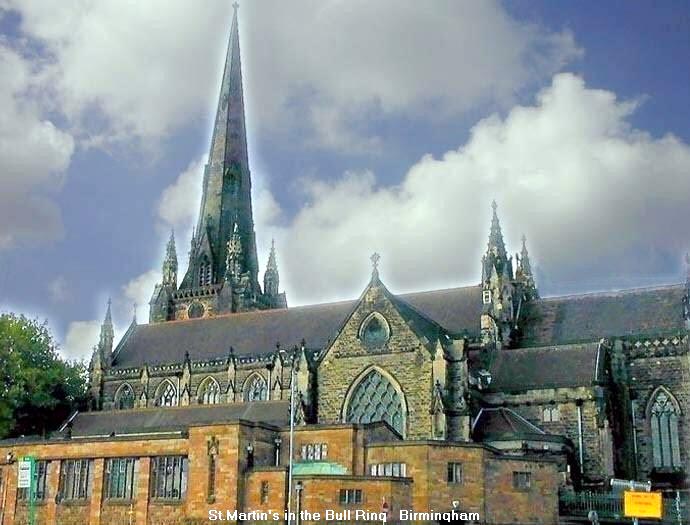
St Martin's in the Bull Ring Birmingham
After World War 2
Not much could be done in the way of restoration until World War 2 had ended. Then the new rector, Canon Bryan Green, had set about raising cash for the work to be done. He had much more success than his two predecessors had, as in a mere six months the restoration fund stood at �100,000; ‘such was the love of old St.Martin’s Church held by real Birmingham people’ as Bryan Green later put it. The architect chosen for the restoration was Anthony Chatwin, grandson of the original architect. Industrialists and Birmingham businessmen dug deep into their coffers to realise this sum which was also enough to build a fine parish hall close to the church. This was completed in 1957 and was also the work of Anthony Chatwin.
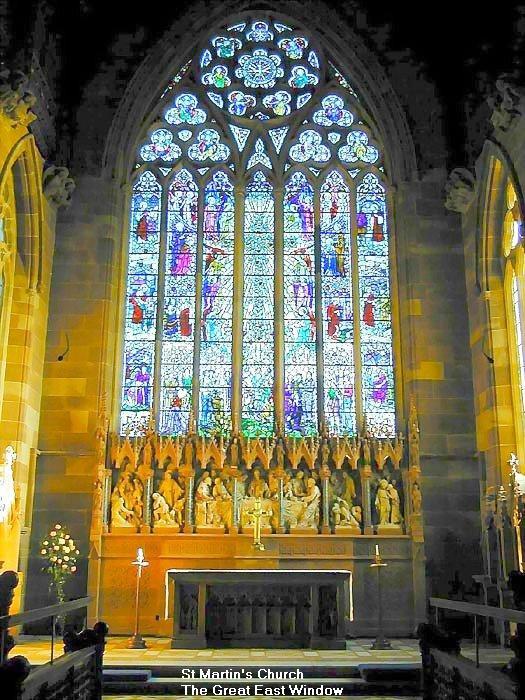
The great west window was restored in 1954; a copy of a window executed by Henry Hardeman in 1875, and which was destroyed in the blitz of World War 2. Also replaced was the great east window – but this time some fragments of the original Victorian window were found after the bombing and incorporated into the 1952 window.
In the early 1980’s disaster again hit the building. Dry rot had attacked the roof and it was ready to collapse. The then Rector Canon Peter Hall launched an appeal to raise �250,000. This was found to be insufficient and the appeal was finally wound up at �442,000 and the roof was repaired. St.Martin’s services had continued uninterrupted by the scaffolding.
Today, St.Martin’s is much more than an interesting building – though it certainly is that! The church welcomes a family of people drawn from all over the city who come within its walls during the days of the week and at the weekends. They pray here, worship here and share together, and it is their wish to pass their experiences of God on to others. (Adapted from ‘St.Martin’s in the Bull Ring’ by English Life Publications)
Millennium
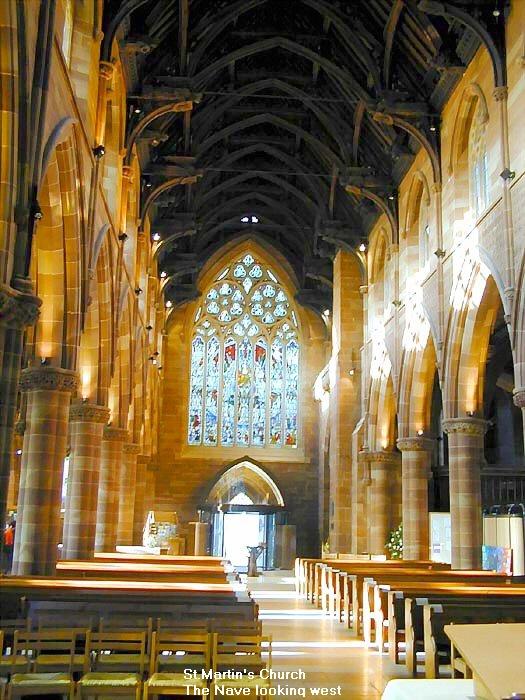
In Millennium year 2000, �1m was spent on a complete facelift of the church interior. For five months, the inside of St.Martin’s has been filled with scaffolding as experts worked to remove more than a century of grime and pollution.
Now, the once dull columns reveal their original pink sparkling sandstone, and the magnificent hammer beam roof has been cleaned to show the carved angels resplendent under new lighting.
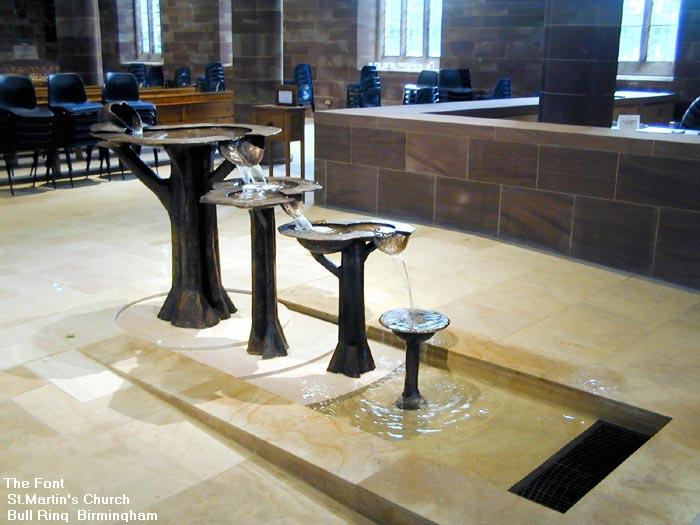
The pews have been stripped back to their original pine, a new limestone floor laid and a new font, which doubles as a work of art stands inside the front entrance.
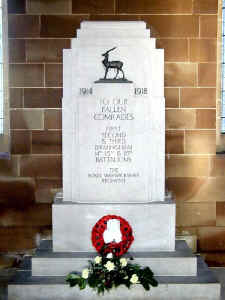
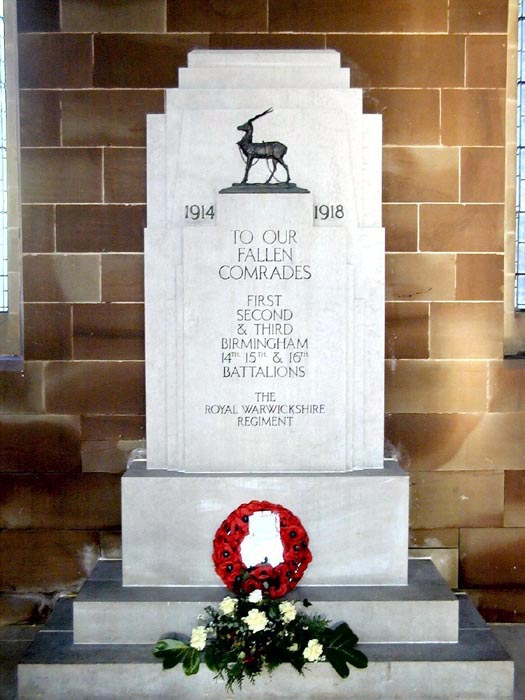
TO OUR FALLEN COMRADES
1914 - 1918
First, Second & Third Birmingham
14th 15th & 16th Battalions
The Royal Warwickshire Regiment
All digital photographs by Colin Hickman, December 2000