
Birmingham�s Railways
Birmingham Central
|
Four railway companies were now operating from or near Curzon Street, together creating the out-of-town inter city station(s) that Birmingham has been promised in recent years. The idea may now have its attractions, but in the 1840�s the situation was far from ideal. Curzon Street was a mile, or one shilling in horse cab fares, away from the town centre, by a very indirect route. This may have been preferable for the railway engineers, but it was hardly convenient for their customers. There were two solutions to this anomaly: one was to create a more direct route to the stations; the other was to direct the trains to a more central site. Birmingham�s answer was to pursue both ideas simultaneously. While the road that was called Albert Street (named after the Prince Consort) was being cut between Park Street and Moor Street, the railway companies were planning to desert Curzon Street for the town centre. The confidence born of steady profits, and a series of mergers, allowed them to turn their attention to the concept of �Birmingham Central� � later known as �New Street�. In 1844 Birmingham and Derby merged with Birmingham and Gloucester to form the Midland Counties Railway. Then in 1846 the G.J.R. and the London and Birmingham formed the LNWR (London and North Western Railway) New Street Station
|
|
|
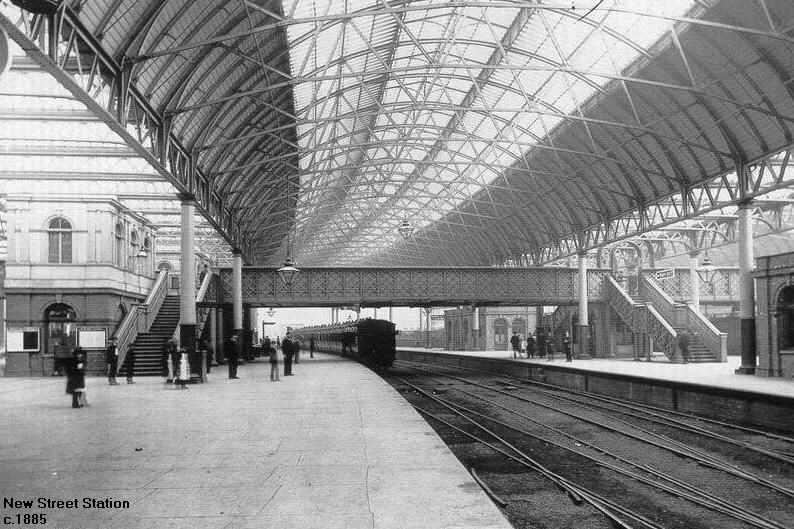
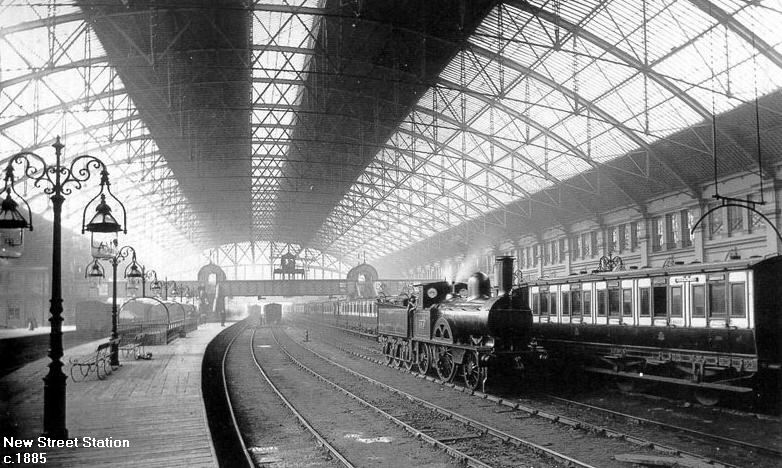
New Street Station formally opened June 1 1854. The new central station was truly grand. At the time it was the largest station in Britain and the roof was a magnificent creation; its height, span (the largest in the world) and length were truly awesome, and the huge area of glass made it light and airy. A Grand central station indeed. |
|
Through it passed the trains of LNWR and MCR. And both companies set out to prevent other emerging railway companies from sharing the facilities of New Street. Two of these were the Birmingham and Oxford Junction Railway and the Birmingham, Wolverhampton and Dudley Railway. In 1848 these companies were merged to form the Great Western Railway. What distinguished the GWR from its rivals was its incompatibility in terms of rail width. At seven feet, its gauge was much wider than the 4 ft 8 in. of the other lines.
|
|

