| A Very Short History of St Joseph's Church and School, Nechells by Richard Scott | |
|
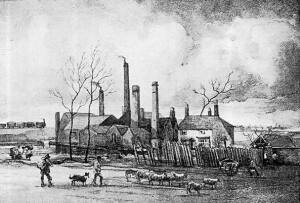
"The present Mission of Nechells Green includes Aston, Ashted, Bloomsbury, Duddeston, Saltley, Witton and Ward End. All these in Catholic Times belonged to the parish of Aston, as also Deritend, Castle Bromwich, Park Hall, Water Orton and Erdington." The above is the opening paragraph of a report on the St. Joseph's Mission, dated 1873. Over the forthcoming years, as we now know, other Catholic churches became established in many of the areas mentioned and are still present to this day. Let us examine the area of Nechells a little further. There is no actual mention of Nechells in Doomsday Book. Nechells lies to the north east of Birmingham. It has seen many changes in the 800 years that people have lived here. "The name of Nechells or Echels signifies a wood. The word �echels� in German (of which Saxon is a branch) signifies what quercus does in Latin. One of the Barons of Dudley gave it to the family of Parles, along with some lands at Hannerworth, or Handsworth. Osbert de Parle conferred all his lands here in Asselles, or Nechells, upon a natural son, called Raynald de Asselles. A descendant of his in 1330, for. �42. He also gave the manor to Simon del Holte, of Birmingham, and his heirs, with whom it shared the fortunes of Aston. It was anciently a very pretty village, for in the 34th year of Edward III. Sir Thomas de Arden,a knight, built a mansion here, as appears by a license granted to him by Robert de Stretton, Bishop of the Diocese, to have a private oratory and a chaplain for himself and his family. About the year 1730 Nechells consisted of four farms and one cottage." Birmingham had been a market town from the 12th century. The farmers in Nechells were able to sell their produce to the town dwellers. By 1760, all land in Nechells was "enclosed", except 10 acres at Nechells Green. There were three rivers bordering the area - the Tame to the north, the Rea to the east and Aston Brook to the west. |
|
| Water was used to drive mills, initially to grind corn and later for industrial purposes. Thimble Mill used water from Aston Brook and was the first metal rolling mill in the city circa l740, but had been used for making blades since 1532. Edge tools were made at Benton's Mill. Another blade mill was Nechells Park Mill, started in 1693. Few traces of mills remain today, except in road names. |
|
|
In 1838, Nechells became part of the borough of Birmingham. With the rapid expansion of industries and higher wages these provided, people surged into the area (the Industrial Revolution) Examples of the industries in the area were: brass foundries, button factories, the metal industry (guns, screws, tools, nails, etc) and jewellers. As well as large factories employing many people, there were workshops of various sizes, some being converted houses and only having a few workers. |
|
|
The population of Birmingham as a whole was:
|
|
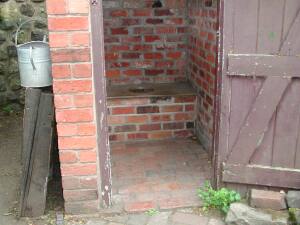
| The type of toilet often shared by a number of families and found at the bottom of a communal courtyard. |
|
|
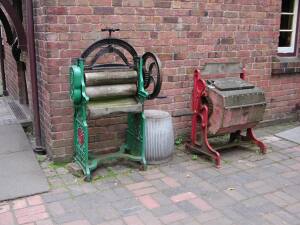
A mangle an a washing machine. Either of which would have been found at the rear of many houses. The mangle was still used by some families well into the 1950's |
| The slum dwellings were demolished and new tower blocks of flats were built, but as it is now realised, these were not the success first envisaged to be and are now slowly disappearing from the city. In 1989, Nechells, together with Duddeston and Bordesley again became a Redevelopment Zone - the area now called Heartlands. Once again, the area saw vast changes take place, changes which are still continuing today. | |
|
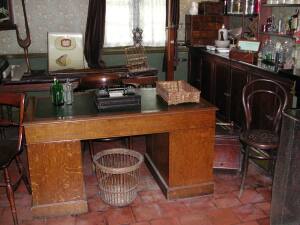
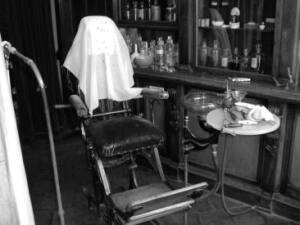
A typical doctors surgery
|
|
|
St Joseph's Church, 1850. |
|
|
|
On Sept. 18th, 1850, the new Cemetery of St. Joseph, Nechells
Green, was consecrated by Bishop Ullathorne, attended by twenty
priests and the choir from St. Chad's, in surplices. All the
Psalms were chanted. The service lasted two hours. There was a
short sermon; and, fortunately, the weather was fine."
The chancel of St Joseph�s Church (where the altar is placed) was built as a chapel for the new cemetery in Thimble Mill Lane. It was in fact the first Catholic cemetery in Birmingham. |
|
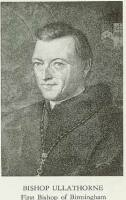
The building was designed by Augustus Welby Northmore Pugin,(1) who was involved in the planning of many fine churches, including St Chad�s Cathedral. Built in Bath stone, the total cost was �800.00. (1) (Augustus Welby Northmore Pugin 1812-1852) Architect and Designer Great Britain's foremost architect and designer of the nineteenth century. He was a man with extraordinary talent, verve and perspicacity. A man who believed in himself and harboured a passion for Gothic styles and the Catholic Church. ) The cemetery covered nearly 5 acres. It would seem that the site of the chancel had been criticised by some. It was thought it would have been better placed nearer Long Acre. However, on completion the view of it on all sides was unimpeded by surrounding buildings and Pugin's decision was justified. Pugin was to die two years later still a very young but already a famous architect. On the 18th September 1850, the chapel and cemetery were consecrated by Dr W B Ullathorne (who was then Vicar Apostolic to the Midlands, but shortly afterwards to become the first Bishop of Birmingham). The first burial was that of a Mary Caffrey, on the September 22nd, 1850. Rev. George Jeffries performed the service. For 17 years, St Joseph's would be used as a mortuary chapel and for funerals for Catholics in the city. It also became a Mass centre, served by priests from the Cathedral. During the early days the Gregorian chant, was revived by the Diocese. It was first used in a service at St Joseph's. It is on record that the furniture for the church was barely sufficient for services. It consisted of a crucifix, 2 candlesticks, a missal, 3 altar cloths, a set of vestments, a chalice, a number of chairs and 2 benches. The Industrial Revolution and the Irish immigration from the famine years of 1848/49 in Ireland had greatly increased the Catholic population in Birmingham, Nechells in particular. Italian immigrants also began settling in nearby St Bartholomew's ward from 1850 onwards. Partially in consequence of the increasing population, early in 1867 it was decided to install a resident priest at St Joseph's. Other factors, which may have helped precipitate the move, were that the new cemetery at Witton, together with its Catholic chapel, was now complete. In addition, the burial area at St Joseph's was nearly full. These factors, together with the already mentioned influx of Catholics into the area, prompted the experiment, (for that is what it was,) of posting the resident priest to St Joseph's, which, it must be remembered, was still only considered to be a chapel for the cemetery. It is recorded, that on the "2nd March 1867 the temporary sacristy with its confessional, porch and sundry other conveniences, were completed at the cost of �35.00. By Mr. McCarty, builder." The following day the church formally opened with a children�s mass at 9.00am. There would appear to have been no night services as," The gas was not on." On the 2nd April 1867, a set of "Stations of the Cross", were being raffled in Handsworth. Having been won by a Mr. Dunkley, he donated them to St Joseph's Church. The church also received 17 benches by courtesy of several men who worked at the nearby Saltley Carriage Company. It would seem that working in their own time, they had made the benches from wood that had been purchased for the task. A number of other people donated items to the church in the early days. Amongst the items were, Altar curtains, a set of large brass candlesticks, a Holy water vat and a statue of the Blessed Virgin. Parishioners made a tabernacle, safe and gas fittings. On Easter Sunday the 21st April 1867, the sanctuary lamp was lit for the first time. The congregation was recorded as being 321 adults.200 children. Father (later Canon) William Greaney was the first resident priest. He performed the first marriage ceremony, on 13th July 1867. The School, of which more will be said later, would be built at the side of the Church, and opened in 1868. |
|
| By 1870, the cemetery chapel was too small. Bishop Ullathorne gave his blessing for its extension. A Bazaar, lasting six days, was held in the Town Hall and raised �656. The Pope, Pius IX, sent a cameo brooch to be raffled. The building of the nave was started in July 1871 and completed the following April. Bishop Ullathorne opened it on Friday 21st April 1872. | |
|
Edward W Pugin (Son of A W N Pugin) designed the church, in the early English style. The cost of the nave and adjoining presbytery was �2658. There were two painted windows in the church, one by John Hardman, who had been involved with Pugin senior in the building of the chapel and St Chad�s Cathedral, the other by the Evans company of Smethwick.
|
|
|
The Victoria History of Warwick describes the church as
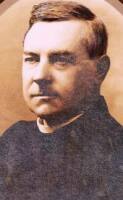
follows. Built in the style of the 14th Century, it is in two parts divided by two wide arches and is heavily buttressed on the North side, (The chancel) The remainder of the church was designed by E W Pugin is also in Gothic style. The gabled west front built of brick with lavish stone dressing, has a projected porch above which is a Gothic opening containing a bell. The 1877-78 census showed that there were approx. 2,200 Catholics in the parish. By 1885, the parish covered nearly 10 square miles. In 1902, the reredos, (the paneling above the altar), was erected by the parishioners to commemorate the Silver Jubilee of Father (later Canon) Arthur L Chattaway, who was Parish Priest at St Joseph's from 1885 - 1922. This was to show the parishioners� high regard for their priest and their appreciation of his educational work in the Diocese. |
|
|
The Centenary Celebrations were held on 21st April 1972, with a
celebrated Mass led by the Most Rev George Patrick Dwyer, Archbishop
of Birmingham.
During late 2000 and early2001 the interior of the Church has
undergone considerable restoration. The formal ceremony to mark
the restoration will take place in May 2002. |

|
|
Parish Priests of St Joseph's Church
|
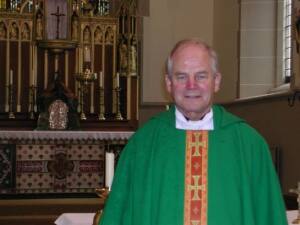
Father Gerry McArdle current Parish priest who has been at the Church since 1994. |
|
|
|
|
Priests from St Chad's 1850-1867. William Greaney 1867-1877 James Whanlon 1877-1885 Arthur L Chattaway 1885-1922 John Rowan 1922-1924 Walter Poulton 1924-1947 Reginald Slade 1947-1957 Anthony Timlin 1957-1968 John J Donnelly 1968-1973 Francis E Gwinnett 1973-1981 Patrick Joyce 1981- 1985 Samuel Frederick Penney 1985-1992 Geoffrey Hargreaves (priest in charge) 1992-1994 Francis Gerard McArdle 1994- Present |
|
|
|
|
|
Assistant Priests Hugh Taylor 1877-1888 John Nock 1878-1884 Francis McCarrick 1884-1885 Thomas Can 1885-1890 Thomas Hanley 1891-1898 George Mesher 1898-1900 Michael O'Hagen 1900-1908 John Budgen 1908-1912 Jeremiah Crowley 1912-1913 Charles Barnes 1913-1920 William Bebbington 1920-1922 Martin Power 1922-1923 Denis Murphy 1923-1931 |
William Matthews 1931-1933 Richard Roche 1933-1935 John Nolan 1935-1941 Patrick Smith 1941-1943 Henry Bouchier 1943-1948 George Smith 1947-1948 Edmund Motherway 1948-1954 John Kiley 1954-1957 Patrick Downey 1959-1960 James Walsh 1960-1961 Peter Gallagher 1963-1965 Alexander McGavin 1965-1967 Nicholas Folan 1969-1971 |
|
Priests Ordained from the Parish |
|
|
St Joseph's RC School, 1867 onwards For several years, prior to 1867, a Mrs Jane Wheatley had kept a school at her house. On Sundays she would allow all the catholic children to meet there after mass. Mr Smallwood, Miss Wheatley and Miss Smallwood taught them. Mr Joseph Rigby would later join them. At this time, the visiting priest would also tutor the pupils with catechism instruction. An average attendance would consist of about 35 pupils. Mrs Wheatley's son would eventually become the Very Rev Dean Wheatley. She died on 22nd January 1901, aged 85 years and is buried in the family vault in St Joseph's cemetery. In the 19th century, schools were not given any money from the Government - all building work and teachers' wages had to be paid by the community or by sponsors. It is clear that the need for a school within the area had been identified. On the 2nd April 1865 door to door collections began to raise funds in order that one could be established. By April 14th 1867 some �115.7s.6p (�115.37 1/2p) had been raised. On his arrival in the parish, Father Greaney was presented with this money, together with a plan for a school that would cost �200.00 to build. Further support from senior diocesan clergy ensured that a school would be built. The school was built at the side of the Church, with an entrance from Long Acre. The school opened on 7th July 1868 and consisted of two schoolrooms. Fifty pupils enrolled. The cost of the building, with accommodation for teachers, was �1,000.Within a short time it was decided that the priest should in fact use the house that had been set-aside for the teachers. This, being for security reasons. It has to be remembered that a number of anti-Catholic riots did occur in Birmingham around this time. St Chad�s did receive damage to windows in one such attack. It is clear that money was raised from many areas in an effort to fund requirements that the school needed. One story tells of Mr Rigby winning a grand piano in a raffle. It had previously belonged to an Amateur Harmonic Society. He gave the piano back to be re-raffled, the proceeds going towards the purchase of a harmonium for the church. The Sisters of Charity of St Paul the Apostle founded and ran many Catholic schools in the Midlands. Their Mother House had been opened at Selly Park in 1864, at the request of Bishop Ullathorne. The Sisters were asked to come to St Joseph's. They lived in the Convent at 143 Nechells Park Road from 13th July 1868 until it was closed on the 24th December 1953. The two sisters who were currently teaching at St Joseph�s continued to do so but now resided at St Chad�s Convent. the first Headmistress was Mother Regis and the Sisters would continue teaching in the School until 1966. |
|
|
The Sisters of Charity of St. Paul the Apostle were established
in France in 1710. Their Mother House being near to the Cathedral
of Chartes. Mademoiselle de Sully, a descendent of one of Henry IV Ministers, founded them. She never actually joined the order, as one of three sisters; she died soon after its commencement.
The order went through some difficult times seeing the loss of
the motherhouse during the French revolution. They would never
return to this property. Later however, Napoleon, then First
Counsel provided them with an old monastery for their use.
|
|
|
|
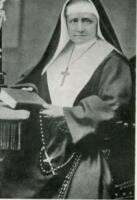
The Order was introduced to England in 1847. One of two sisters who arrived was Sister Zoile (Genevieve) Dupuis, who, would be the Mother Superior at Selly Park, when the order took up their duties at St Joseph's School. |
|
Over the forthcoming years supporters and staff at the school, like
the church, resorted to all manner of fund raising to support the
school and its necessary equipment. After one such bazaar it is
recorded that the school made �656.00 after expenses. In 1870, the school was extended, as there were many more pupils. The classrooms were level with Long Acre and built on arches, which provided a covered playground for the pupils. The arches were eventually utilised and made into classrooms. The fees in 1874 were ld - 4d (I/2p - 2p approx.) per week and over half the places were free. |
|
| In 1877, the school was divided into 3 separate departments - Infants, Girls and Boys, each with its own Head-teacher. The school's needs continued to expand, by 1896, Father Chattaway commissioned a single storey building to be built at the Thimble Mill Lane entrance to the Church. This was originally the Boys' School and remained there until demolished in May 1998 for road widening. |
|
|
From 1902, Church schools were given financial help and so the
Parish Priest was no longer responsible for teachers'
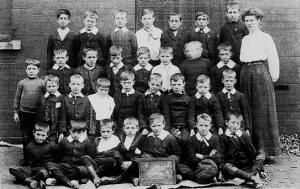
salaries. The Headmistress of the Girls' School was Mother Dunstan, who was at the school from 1900 - 1930. Sister Marie was Head of the Infants for a similar period (1903 - 1936). Mr Andrew Kinsella was Headmaster of the Boys' school for 30 years until his untimely death in 1918. |
|
|
Mr Meehan became Headmaster of the Boys' School after Mr Kinsella. During this time, |
|
Nechells was subject to slum clearance and people were moved away. The numbers of pupils dropped drastically. During the war years, pupils were evacuated out of the city. When Mr. Meehan retired the depleted Boys' and Girls' Schools were amalgamated under Sister Margaret, who had been Headmistress of the Girls' School since 1934. She retired in 1950, by which time there were only 111 pupils on roll. The Boys' School building was used as an annexe for the younger pupils.
|
|
|
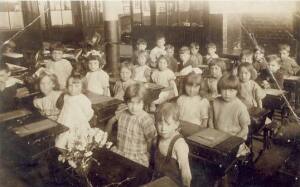
Infant Class 1930. Only one pupil identified to date.Mary Lyden.
2nd from left.3rd row. |
|
|
|
|