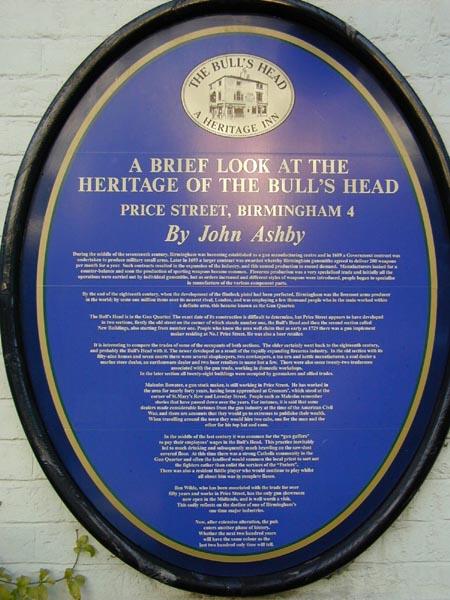
A brief look at the heritage of the Bull's Head
|
|
| During the middle of the seventeenth century, Birmingham was becoming established as a gun-manufacturing centre and in 1689 a Government contract was undertaken to produce small military arms. Later in 1693, a larger contract was awarded whereby Birmingham gunsmiths agreed to deliver 200 weapons per month for a year. Such contracts resulted in the expansion of the industry, and this caused production to exceed demand. Manufacturers looked for a counter-balance and soon the production of sporting weapons became common. Firearms production was a very specialised trade and initially all the operations were carried out by individual gunsmiths, but as orders increased and different styles of weapons were introduced, people began to specialise in manufacture of the various component parts. |
|
|
By the end of the eighteenth century, when the development of the flintlock pistol had been perfected, Birmingham was the foremost arms producer in the world; by some one million items over its nearest rival, London, and was employing a few thousand people who in the main worked within a definite area, this became known as the Gun Quarter. |
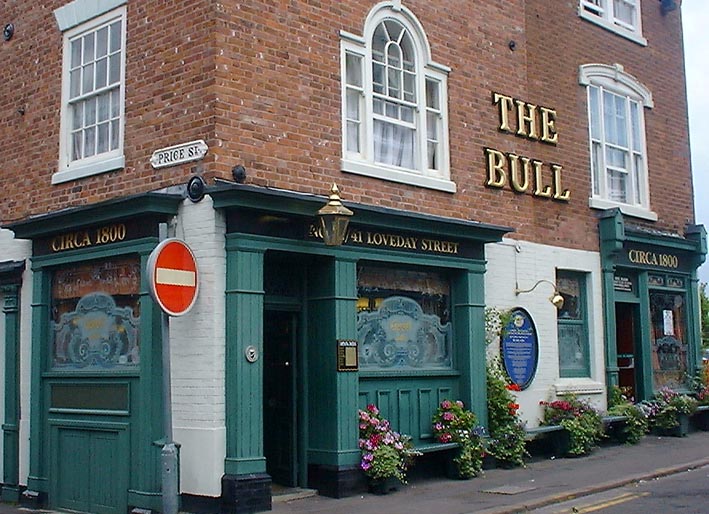
| The Bulls Head is in the Gun Quarter. The exact date of its construction is difficult to determine, but Price Street appears to have developed in two sections, firstly the old street on the corner of which stands number one, the Bulls Head and then the second section called New Buildings, also starting from number one. People who know the area well claim that as early as 1729 there was a gun implement maker residing at number one Price Street. He was also a beer retailer. |
|
|
It is interesting to compare the trades of some of the occupants of both sections. The older certainly went back to the eighteenth century, and probably the Bulls Head with it. The newer developed as a result of the rapidly expanding firearms industry. In the old section with its fifty-nine houses and seven courts there were several shopkeepers, two cow keepers, a kettle and tea urn manufacturer, a coal dealer, a marine store dealer, an earthenware dealer and two beer retailers to name but a few. There were also twenty-two tradesmen associated with the gun trade, working in domestic workshops. In the latter section, gunmaker’s and allied trades occupied all twenty-eight buildings. |
| Malcolm Bowater, a gun stock maker is still working in Price Street. He has worked in the area for nearly forty years, having been apprenticed at Greeners, which stood at the corner of St.Mary’s Row and Loveday Street. People such as Malcolm remember stories that have been passed down over the years. For instance, it is said that some dealers made considerable fortunes from the gun industry at the time of the American Civil War, and there are accounts that they would go to extremes to publicise their wealth. When travelling around the town they would hire two cabs, one for the man, the other for his top hat and cane. |
|
|
|
In the middle of the last century, it was common for the ‘gun gaffers’ to pay their employees wages in the Bulls Head. This practice inevitably led to much drinking and subsequently much brawling on the saw- dust covered floor. At this time there was a strong Catholic community in the Gun Quarter and often the landlord would summon the local priest to sort out the fighters rather than enlist the services of the ‘Peelers’. There was also a resident fiddler, who would continue playing whilst all around him was in complete fiasco. |
|
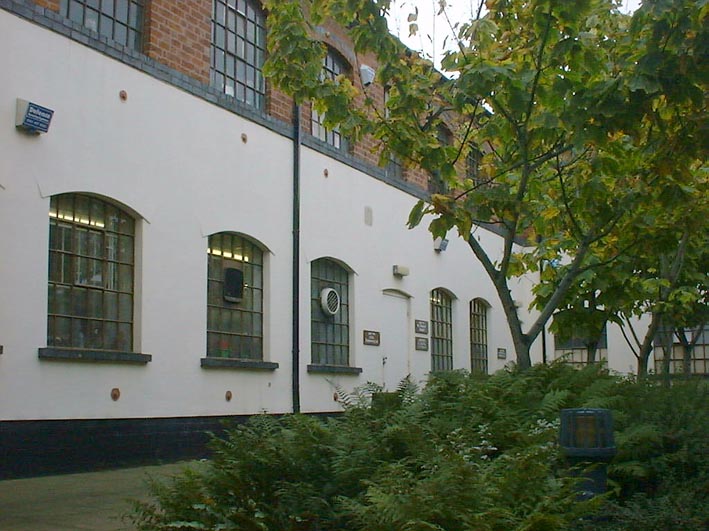
Ben Wilde, who has been associated with the trade for over fifty
years and works in Price Street, has the only Gun showroom now open
in the Midlands, and is well worth a visit. This sadly reflects on
the decline of one of Birmingham’s one time great
industries.
Benjamin Wild & Son Website |
|
|
|
Now, after extensive alteration, the pub enters another phase of
history. Whether the next two hundred years will have the same
colour as the last two hundred only time will tell.
The Bull Website
|