
A brief history of Birmingham
The Bull Ring in the Eighteenth Century
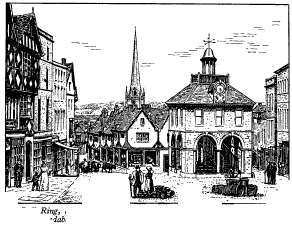
Here is a picture of the heart of Birmingham in the eighteenth century, for
you see in it the. site of the principal market, and the Market Cross where
the governing body of the town met.
Occupying the middle of the Bull Ring can be seen a row of butchers’ shops, known as the Shambles
The spire is that of the Parish Church of St. Martin’s. The buildings round the church became known as the Roundabout Houses. Many of these were built actually inside the churchyard.
Crowds flocked from neighbouring parts, eager to buy the wares of the industrious and enterprising craftsmen of the town. To be situated thus near the Bull Ring, the hub of the market, was worth a goodly rental.
The name Bull Ring came about as It was the ring where bull-baiting, one of the most popular and most cruel sports of the time, was staged. As late as 1798, said Aris’s Gazette (a local newspaper), a memorable bull-baiting took place. "On the day in question, the bull was baited in a field behind the Salutation Inn, Snow Hill, and in conformity with the wishes of the respectable inhabitants (who desired to put down the nuisance) the Birmingham Association, a body of militia voluntarily formed by the trading class, undertook the formidable task of capturing the bull and dispersing its tormentors.. The Association assembled in the Bull Ring and marched to the baiting place at Snow Hill. On arriving there, they found that the mob having notice of the attack, had transferred themselves and the bull to Birmingham Heath." Here it was captured, and the bull-baiting stopped. After this the sport ceased to be held in the Bull Ring, and was staged at Handsworth, which was outside the boundaries of Birmingham at that time.

